
Words and More Words (“Thoughts,” Part 2)
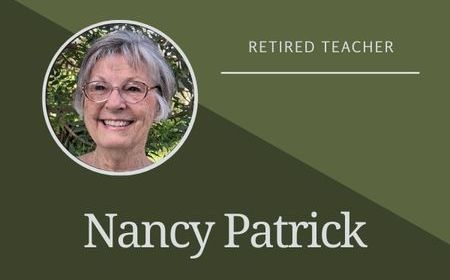
By Nancy Patrick
People who have known me only as an adult express surprise when I tell them that I was one of the quietest students in all my classes. Because of my extreme shyness, I sometimes felt intimidated by more outgoing children who seemed confident and self-assured. One of my elementary school teachers actually told my mother during a parent-teacher conference that she wished I would at least do something that would require her to scold me. I think my teacher felt that I might have a “problem.”
Well, I proved her wrong as I grew up and gained my own voice. As a matter of fact, one of my new friends at Wesley Court, a gentleman, suggested that when I joined a dining table with at least one other woman, the men hardly had a chance to speak. (Criticism or jest—I’ll need to think about that one).
As a matter of fact, verbosity abounds in both my oral and written communication. (I do love the thesaurus tab on my computer.) When Loretta Fulton sent a sentence for clarification from one of my articles, I told her that I can always make a complex sentence from a simple idea. However, as I share some of my “thoughts for the day” from my teaching career, I will strive for clearness and brevity (Spirit of Abilene).
*If nobody loves you, you can be sure it is your own fault.
As a bashful child, I used to tell my mother that no one liked me—I didn’t have any friends. She pointed out to me that my watching the neighborhood kids play through our back door window didn’t let them know I wanted to join in the fun. I had to learn to initiate relationships if I wanted to have them.
*Fall in love with yourself and you will have no rivals.
Over the decades of teaching teenagers, I became acquainted with all sorts of personalities. The most annoying types were the ego-centric, self-absorbed individuals who considered themselves the best-looking, the smartest, the funniest, and the most likely to succeed. I also noted that their circle of friends appeared much smaller than the students who tried to make friends and help peers through the tough adolescent years. Inclusion opens the door that invites in friends.
*The remedy for wrongs is to forget them.
Learning to forgive offenses presents one of the hardest lessons people have to learn. I say “have to” because when we don’t learn to forgive, we will become sad, angry, lonely, and bitter people. I think “forgetting” means to put the thought of the offense in a distant mental file; we cannot truly erase the memory of a mean or painful event, but we can decide not to focus on it.
*Love your enemies for they tell you your faults.
This oxymoronic thought carries a distasteful truth. If we shut out people we dislike and keep close only people who flatter us with insincere praise, we rob ourselves of seeing an accurate depiction of our true selves. Robert Burns wrote “O wad some Power the giftie gie us / To see oursels as ithers see us!” (“To a Louse”). I updated the language for my students: God grant us the power to see ourselves as others see us.
*Who loves God loves his brother, also.
Many adages deliver difficult but truthful advice. Many people say they love God, but they also have a list of their enemies’ names. That list may contain names of relatives, friends, acquaintances, colleagues, or even public officials they don’t personally know. Holding grudges, looking for faults, exaggerating wrongs, making threats, posting negative information on social media, or simply being mean-spirited displeases God who loves His creation.
As you might imagine, some of the thoughts for the day I wrote on my classroom chalkboard prompted questions and discussions. I enjoyed the conversations sparked among my students because they used this unstructured time to express their thoughts and beliefs freely. They also showed maturity as they listened to others while respectfully disagreeing in a non-judgmental space.
Nancy Patrick is a retired teacher who lives in Abilene and enjoys writing

