
A Tip about Change

By Nancy Patrick
I recognize all the symptoms of old age on a daily basis. They began during my 40th year when doctors began saying, “At your age . . ..” One of the first times this occurred, my ophthalmologist told me that people my age needed bifocals. Others referred to diagnostic procedures I could avoid because I was past the age to worry about those conditions. Those tips told me that change would never stop.
Many customs in social behavior have also evolved. I remember following many rules of proper dating and other social interactions between young people. For example, in my teen years, I learned that girls should not initiate relationships—that behavior would make them seem forward. The same held true for phoning or asking someone for a date. I didn’t realize at the time how much stress boys experienced by having to initiate contact.
Another important social more dealt with attire. School, churches, and work places implemented dress codes designed to maintain certain decorum in those environments. In the 1960s, the girls at Abilene High School had to wear dresses whose hemlines had to touch the floor when the girl got on her knees. (Yes, occasionally she had to prove her claim of her dress’ appropriate length!)
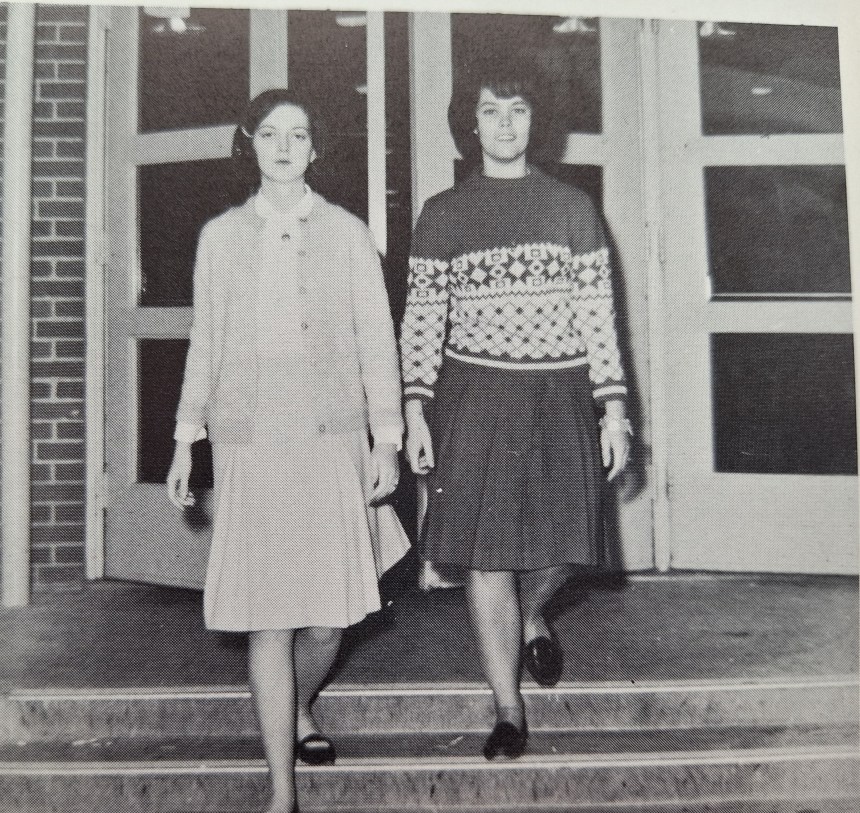
Abilene High School girls from 1966 Flashlight yearbook
Of course, the dress code applied to boys as well. They wore slacks with tucked in shirts with belts and had to have haircuts no longer than their collars, no facial hair, and socks with closed-toe shoes.
I have to say that as a teacher myself for 40 years, I experienced several examples of culture shock as my students’ fashions changed dramatically and rapidly. The concept of “modesty” seemed to die during the 1960s.
One of the more impactful changes during my adolescence involved the divorce rate. I grew up in the ’50s and ’60s when most families consisted of biological parents with their children. The divorce rate signaled the dissolution of that nuclear family and sparked many other changes.
After divorces, parents then began dating again, many living with partners rather than marrying them. These arrangements included many forms of blended families that brought multiple stressful situations for all family members as morality guidelines shifted.
Another social change that has puzzled me somewhat and sometimes puts stress on me regarding expectations of friends. This behavior relates to gift-giving. My generation considered gifts as presents given freely for special occasions. I learned to write hand-written thank-you notes to people who gave me gifts, always mentioning the gift and my appreciation.
When I was engaged, my church hosted a bridal shower for me. Back in those days, bridal showers did not specify types of gifts such as kitchen, laundry, linen, or furniture. That meant all gifts could find a useful place in a new home.
I noticed during my career that I began receiving invitations to bridal and baby showers for children of my colleagues. I had never met their children, nor had I socialized with the co-workers. I attended the showers and took gifts, but this new dimension of gift-giving puzzled me somewhat.
I also noted that many invitations stipulated certain stores and included a gift list of desired items. I found those lists somewhat off-putting since I did not personally know the recipients. I enjoyed all the gifts I received from my guests because I had personal relationships with all of them either through family, church, work, or school.
Another new trend, the GoFundMe page on Facebook, bothers me somewhat. That program started with good intentions of helping families in crisis. Destructive fires and sudden deaths can cause great financial stress for some. Helping people get back on their feet after a tragedy is a worthy cause that I could certainly appreciate and support. However, the trend soon became a way to ask strangers for money for all sorts of pet projects or personal causes. Some GoFundMe pages have proved fraudulent, with the gathered money never going to the intended recipient.
A similar plea that I’ve noticed recently involves a person who is changing careers and asks for donations to help the person furnish an office, buy supplies, or tide him or her over until the new salary starts. As a teacher, I spent hundreds (probably thousands) of my dollars for my own needs as well as my students’ needs. I gratefully accepted the occasional gift offered by the school district but never asked others to fund my projects.
As ideas of generosity have evolved over time, I have come to the realization that the spirit with which a gift is given is much more important than the monetary worth of the gift. The Bible mentions the value of giving many times. If we live long enough, we will see the worlds of our youth change from generation to generation. That does not mean the human heart changes in its fundamental essence and spirit. Growing old presents difficulties physically, mentally, socially, culturally, and spiritually. Regardless of the age of the physical body, the soul still seeks solace in its creator and sustainer.
Nancy Patrick is a retired teacher who lives in Abilene and enjoys writing

