
A Postscript to the Indian Wars: The Kerfuffle on Custer Street

Editor’s Note: November is Native American Heritage Month in the United States. It honors the history, culture, traditions, and contributions of indigenous people. Darryl Tippens pays tribute in his column.
By Darryl Tippens
“The great force of history comes from the fact that we carry it within us . . . history is literally present in all that we do.” —James Baldwin
John Leonard Yellow Eagle and I were classmates at Thompson Elementary School in western Oklahoma. Leonard, as we called him, was Cheyenne—a year older than I, tall, thin, and athletic. I was shorter, but compact and wiry, a well-fed teacher’s son who won his share of foot races. In my sixth-grade year President Eisenhower’s Council on Youth Fitness tested schoolchildren across the country, even at our little school. The local paper reported that some of my classmates scored in the top ten percent of the nation. Leonard’s name was on that list. Mine was not.
Leonard and I were not friends, but we weren’t enemies either, as far as I knew—until one day in the sixth grade. At recess Leonard walked over, slammed into me, and yelled in my face, “You bug me! You bug me, man!” I wasn’t looking for trouble. I edged away, puzzled. He came at me again, harder: “You bug me! You bug me, man!” Recess ended, and I didn’t think much about it. But the next day it happened again.
After the second day, I hurried over to the high school, where my dad taught. Dad was a World War II Army Air Corps veteran and a strict disciplinarian. He listened to my story. “Well,” he said, “you might have to fight him.” The next day I told Leonard I would fight him, but not on the playground. It would have to be a proper, arranged fight: after school, across Custer Street, on the lawn facing the school. It would be my first and last school fight.
News of our match raced like a prairie fire through Thompson Elementary. On a cold, early spring afternoon, we faced off inside a ring of grade schoolers. With four brothers, I was used to roughhousing, but I had never been in a real fight before. It’s all a blur now, but I remember rolling furiously on the grass in patches of snow, burning at the injustice of Leonard’s unprovoked attacks.
To my surprise, I pinned him. I rubbed snow in Leonard’s face and made him say “Calf-rope!”—the expected sign of surrender in those days. I had won! The crowd dispersed, and I walked home alone. I didn’t tell Dad or anyone at home what had happened that afternoon. Oddly, I didn’t feel good about it. I soon learned it wasn’t over.
The next morning Leonard and I were summoned to the principal’s office. Waiting outside Mr. McCarty’s door, I was overcome with panic. I had never been in trouble at school, but I knew the rules: no matter who started it, if you got in a fight, you got paddled. I glanced at Leonard. There he sat, calm and unruffled. I suspect he had made many such visits to the principal’s office. For him, it was just another day.
Mr. McCarty was stern and to the point. The school’s jurisdiction, he informed us, extended from the school grounds all the way to our front doors. That was news to me. After a lecture, we promised never to fight again, and he sent us back to class. There would be no paddling. I was very relieved, but I felt ashamed.
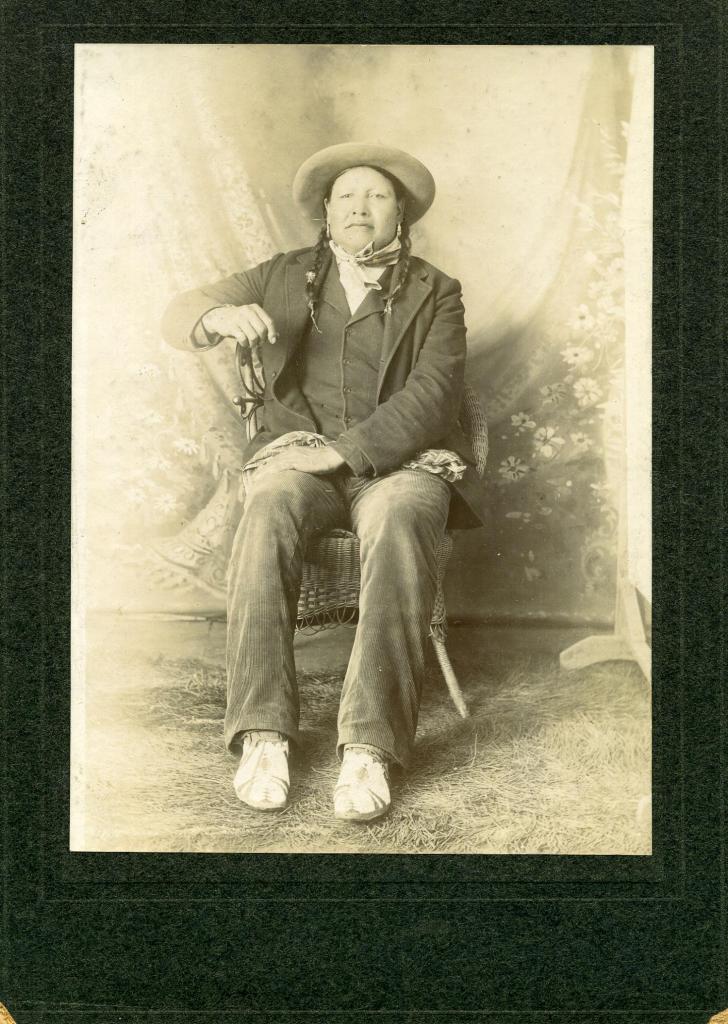
Leonard Yellow Eagle near Weatherford, Oklahoma c. 1900–1905. Probably the grandfather and namesake of the classmate Darryl fought in sixth grade. (Courtesy of the Oklahoma Historical Society.)
Leonard and I never fought again. By ninth grade, he had moved away to attend Chilocco, an Indian boarding school in the far northern part of the state. He played football in high school, graduated, and later earned a degree in counseling at a college in Memphis. I never saw him again.
Leonard died last year. His obituary described him as a “proud member of the Native American Church” who was “deeply connected to his cultural heritage.” He “loved participating in ceremonial activities with his tribe, attending powwows, and Gourd dancing,” and he was known for “his lively spirit, his love of laughter.”
I have long pondered that fight with a Cheyenne boy in the sixth grade, and its meaning has grown clearer with time. And now, after so many years, I understand something of the ghosts that were present in that kerfuffle on Custer Street.
There are many things my eleven-year-old self could not see, things I would piece together only decades later from histories, government reports, and the recollections of those who lived them. Leonard’s father had been a student at the Seger Indian Training School, founded by John Homer Seger in Colony, Oklahoma, just a few miles from where we fought. Leonard never spoke of it.
Oklahoma had seventy-six Indian boarding schools, more than any other state, and like the others, Seger used harsh discipline to erase Indian identity: children were punished for speaking their tribal language, for wearing traditional dress, or for engaging in Native ceremonies. It was far from the worst of those schools, but its dark side haunts me. In August 1971 it was placed on the National Register of Historic Places. A month later it burned down under mysterious circumstances.
My knowledge of the Seger school doesn’t come only from books and archives. My father’s first teaching job was in Colony, after the public school took over the closed Indian school. Dad taught vocational agriculture in one of the old Indian school buildings, and our family lived on campus in a house once occupied by the staff. I remember being frightened by the dark basement rooms of a building near our house. The rooms had bars on the windows. I was too young to know that unruly Indian children had been locked up there, but somehow I knew it was a bad place.
Other ghosts rise from the nearby Washita River, a few miles from my family’s homestead. At dawn on November 27, 1868, General George Armstrong Custer’s 7th Cavalry attacked an encampment of Cheyenne on the banks of the Washita. The band was led by Black Kettle, a chief who was seeking peace with the whites. The soldiers killed Black Kettle and many women and children, carried the surviving women and children off to Camp Supply, burned the lodges, and slaughtered some eight hundred horses, the tribe’s main means of survival. Custer meant to starve whoever was left. I grew up hearing about the “Battle of the Washita.” Today many call it the Massacre on the Washita.
Some of those survivors settled in Colony, next to the very school Leonard’s father attended, where the old men told and retold the story. Leonard’s father surely heard it, too, from his own mother, Minnie “Little Woman” Seward, who was four years old in 1868. My classmate grew up among people for whom the Washita tragedy was not history but living memory.
The ghosts of those days are not remote for my family either. After the Dawes Act of 1887, the Cheyenne-Arapaho reservation was broken into allotments, and on April 19, 1892, some 3.5 million acres were opened to white settlers. Within a decade, all four sets of my great-grandparents had arrived and laid claim to land in Custer County, Oklahoma Territory. The last to arrive was Lucien V. Rector, a Methodist minister from Indiana. In 1901 he took over an abandoned claim, and he soon learned why it had been abandoned: much of the former reservation land was not suited for farming. In 1910 he bought a second, far better tract from Red Bird, the Cheyenne widow of Spotted Horse. It was rich bottomland in the Washita River valley, downstream from where Black Kettle’s people died.
So my skirmish with Leonard, ninety years after the massacre on the Washita, did indeed have a history. I wonder whether our fight was a sign of transgenerational trauma. A culture that prizes stoic silence often passes down its sorrow, despair, and anger in gestures rather than in words.
Back then I didn’t know the Arthurian legend of the wounded Fisher King, who could not be healed until Percival asked him, “What aileth thee?” As a sixth grader I lacked the capacity to imagine the reasons for Leonard’s anger, or to ask a question as simple as “What are you going through?”
All these years later, I can still see that circle of white kids cheering me on as I humiliated an Indian boy, and I am embarrassed. I marvel at the ironies. We fought beside a street named for George A. Custer, on the hill where, local lore says, the flamboyant general once rode his horse, in a county that bears his name. Settlers chose the name, four years after the land run. When I was a kid, Custer was just the name of a street and a county. To Leonard’s people, it was something else.
Ignorance of the past does not disarm it. The past simmers in our souls and in the body politic, breaking through when we least expect it. If Leonard and I had ever met as adults, I would have known where to begin. I would have looked him in the eye and asked the question: “What are you going through?”
Darryl Tippens is retired University Distinguished Scholar at Abilene Christian University

