
Seeing Children Differently
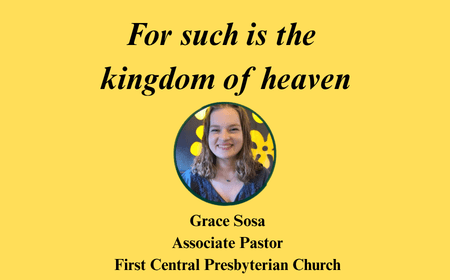
By Grace Sosa
I have been doing children’s sermons for over ten years now, first in high school at First Baptist Church in Pecos. Now I take turns with my husband as part of our roles as associate pastors at First Central Presbyterian Church in Abilene. Most of the churches I have seen that still have a children’s sermon ask the children to come up and sit on the steps or on the floor close to the front. We used to do that, too.
But a few years ago, we made the decision to invite our children up to the communion table for the children’s sermon. We had several reasons for this decision. We wanted the children to face the person speaking instead of being distracted by everyone in the congregation. We didn’t want to sit on the floor in our clergy robes. It was an easier angle for our livestream to capture.
We had our reasons for this change, but we were a bit nervous with how our traditional, Presbyterian congregation would react. After all, the communion table is a sacred place. We don’t view it quite the same as Catholics or Episcopalians do, but it is still more than just a dining table. What if the children put their elbows on the table? What if they giggled or pushed each other to find a spot? What if they knocked down a tray of bread or juice?
Spoiler alert: all of those things have happened, except the last (so far).
The reality is, kids will be kids. They bring their authentic selves to the table. One little boy has made up motions to the Gloria Patri and runs to the table in an effort to be the first one to the children’s sermon. Another little girl hoists herself up on her elbows and swings her feet in the air. One little boy brought up his toy robot and played with it as he listened. Another little girl brings a new stuffie every week and wants to share its name with us.
The truth is, I used to dread children’s sermons. They’re actually hard to write. How do you tell kids about David and Bathsheba? Or how do you explain the Trinity without using an analogy that borders on heresy?
And even if you have a great children’s sermon prepared, you never know what will happen. I know what will happen when I preach to adults. They will sit still and listen. And (occasionally) laugh at your jokes. But with kids, you never know. If you plan to ask lots of questions, you might be met with silence or you might not be able to get them back on track. They might give you a question from left field like, “Where do you buy the communion bread from?” Sometimes I know the answers, and lots of times I have to say. “I’m not sure, but I’ll try to find out!”
But recently, children’s sermons have been growing on me. For one thing, adults regularly tell me how much they learn from the children’s sermon. Maybe they didn’t grow up in church, grew up in a different tradition, or just had never heard what we were learning that day. Just like the best children’s books and movies speak to adults, so too should children’s sermons.
In a session meeting recently, our elders were asked to go around the circle and say what they love most about our church. One of the moms said that her favorite part of church is the children’s sermon. She said that she feels like we love her children so well and that when we invite the children to the table, we invite the whole congregation to listen in.
Since I grew up Baptist, I was surprised that Presbyterian children could participate in communion at such a young age. In Baptist churches, you don’t partake in communion until you’re baptized, and most children aren’t baptized until they’re around seven or eight. But in Presbyterian churches, we practice infant baptism, so very young children can participate in communion.
The first time I saw a young child take communion, I thought, “They don’t understand what they’re doing.” And I still think that. But now I also think that maybe none of us understands what we’re doing. Being a teenager or an adult doesn’t make you comprehend the mystery of this sacrament. We don’t completely understand what we are doing, but God does. The disciples didn’t understand what Christ meant at the Last Supper, but they still ate and drank with him.
So we invite our children to the Lord’s Table—for the children’s sermon and for communion. We invite them to bring their dancing and their swinging feet, their robots and their stuffies. Because that is what Jesus would do. Jesus would listen to their questions with more patience than I do. He would say, “This place is for you. This meal is for you.” For such is the kingdom of heaven.
Grace Sosa is associate pastor for youth at First Central Presbyterian Church


Beautiful piece, Grace, and beautifully written. I identify with your comment about the children’s limited understanding of rituals because it made me think of my own limited understanding of God. Even so, he allows me at the table.
LikeLike