
What’s in a Name?

By Nancy Patrick
In Shakespeare’s Romeo and Juliet, Juliet asks Romeo the title question when she tries to rationalize the relationship between herself, Juliet Capulet, and her lover, Romeo Montague. As a Capulet, Juliet knows that her family and the Montague families hate each other. These young people have lived their short lives within the framework of this longstanding feud. Yet, in her passionate love for Romeo, Juliet questions the logic of a name separating the two young lovers.
We might think her question a sound one. Why in the world should she hate Romeo just because he shares his family’s name? He is the individual human being she loves regardless of his name. Certainly, we have all heard of feuds between families who have fought so long they don’t remember the initiating incident.
This hatred of others based on names or tribes seems illogical; however, we know it not only exists but thrives all over the world. We just heard our President threaten to destroy the entire Iranian civilization if their leaders didn’t comply with his political requirements.
We know that even in the Old Testament, Jehovah commanded Israelites to annihilate enemy tribes that occupied the land he had given them (Deuteronomy 20). The reference offers explanations regarding the rules of those attacks, but the attacks are indeed against tribes of specific names.
How can names (labels) carry so much emotion? Today, we hear many references to names of individuals and groups that provoke feelings of prejudice, anger, fear, hatred, and vengeance. The name Putin connotes aggression and entitlement. The name Hamas immediately evokes thoughts of vicious, murderous people raiding young Israelis attending an outdoor concert.
Some names are synonymous with the qualities that have become associated with the person who held that name. These include Adolf Hitler, Muhammad, Jesus Christ, Moses, Judas, Rock Hudson, Liberace, Donald Trump, Mahatma Gandhi, Jimmy Carter, and Hermann Goring. Obviously, my list is limited, but I’m sure you know exactly what I mean about connotations associated with names.
Historically, the name Joseph McCarthy recalls memories of the Red Scare in this country in the 1950s. Senator McCarthy became obsessed with the idea that communists had infiltrated many facets of American society, and he embraced the mission of finding and ruining these people who threatened what he believed was this country’s democracy.
One of the problems with joining named groups, whether family or social, surfaces when people begin looking for enemies everywhere. After the 9/11 terrorist attacks in this country, many people immediately grouped all Muslims and descendants of Arab countries as terrorists. Many people committed acts of violence because they had developed a phobia to any name associated with the Mideastern societies.
The danger of name-calling prevails in the political climate in this country today. In the 2015 Presidential campaign, Donald Trump began using a technique of attaching epithets (nicknames) to all his opponents (Trump’s Name-Calling). I won’t bother listing many, but notably Crooked Joe, Crazy Hilary, and Comrade Kamala illustrate the juvenile attempt to denigrate those he does not like.
Although my family name, Smith, is one of the most common in this country, my parents instilled in my sister and me that we should behave in such a way that brought respect to our family name. Even though our family was far from high society, we knew that misbehavior would bring embarrassment or shame to our parents. I felt an enormous responsibility to make my parents proud of me.
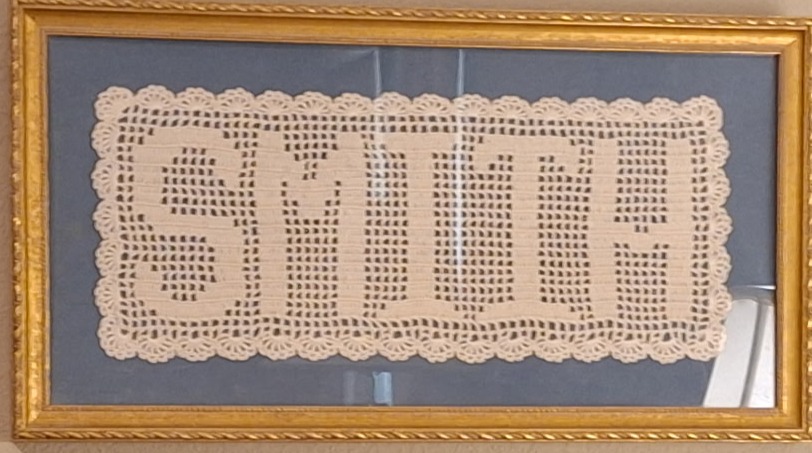
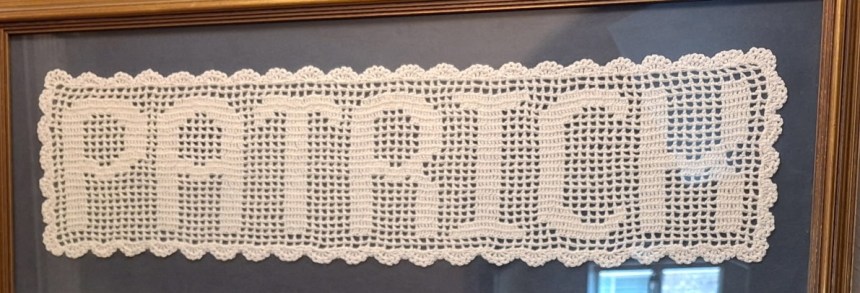
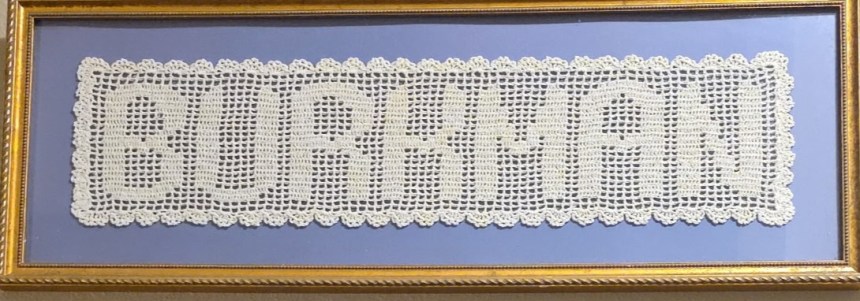
My mother loved crafts, especially crocheting. She loved her two sons-in-law, Mike Patrick and Stanley Burkman, so she resolutely crocheted family names for each of our households before her arthritic hands ended her ability to perform detailed tasks. Each of our families still proudly displays them.
Perhaps my favorite literary example of the importance of names is Arthur Miller’s The Crucible. Miller actually based his play on the McCarthy era and its emphasis on naming people on his communist list. McCarthy threatened witnesses to name people he suspected of communism to avoid their own prosecution.
In The Crucible’s witch trials, if witnesses refused to name neighbors on the court’s list, the witnesses themselves would be charged as witches. When the court called John Proctor to testify, he refused to name any of his neighbors as “witches.” Proctor pleads with the judges: “Because it is my name! Because I cannot have another in my life! Because I lie and sign myself to lies! I am not worth the dust on the feet of them that hang!”
In a time of volatile emotions and extremely conflicting moral, ethical, and spiritual values, names continue to have power. Whether we identify with the name Christian, Protestant, Catholic, Muslim, American, Israeli, Smith, Jones, Biden, or Trump, we must first and foremost identify with the name “human being.” Unless we can learn and accept our place in this vast society and recognize that all people all over the world have their places alongside ours, we will never achieve peace.
Nancy Patrick is a retired teacher who lives in Abilene and enjoys writing

