
God’s Self-Revelation in the Least of These
By Mark Waters
On November 16, 1989, members of the Salvadoran Atlácatl Battalion—trained and armed by the School of the Americas in Fort Benning, Georgia—entered the campus of the University of Central America (UCA) in San Salvador where they murdered six Jesuit priests, their housekeeper, and her 15-year-old daughter. The priests served on the faculty of the University.
Their primary target was University Rector and Professor of Theology, Ignacio Ellacuría. His crime? He consistently called for peaceful negotiations to end El Salvador’s civil war (1980-1992). Salvadoran authorities feared that Ellacuría’s outspoken opposition to the war might influence the United States to reduce or withdraw their one-million dollar per day funding for El Salvador’s right-wing military dictatorship.
A second reason for targeting Ellacuría and the other priests was their service to the poor which included calls for land reform. Since the late 19th century, most of the agricultural land in El Salvador has been concentrated among a small group of wealthy elites known metaphorically as “the fourteen families.” A large portion of the population, consequently, was forced into sharecropping and crushing poverty. Calls for land reform threatened the wealthy oligarchy that was in collusion with the military dictatorship. The voices calling for reform had to be silenced.
Moreover, government propaganda equated concern for the poor with communism. The mantra “Be a patriot, kill a priest” expressed the extreme hostility. Under similar stigma, Brazilian Archbishop Hélder Pessoa Câmara said, “When I give food to the poor, they call me a saint. When I ask why the poor have no food, they call me a communist.”
Visiting the site where the murders occurred was one of many learning experiences of McMurry University students, staff, and faculty during a spiritual pilgrimage and study abroad course in Liberation Theology held May 14-24. Dean of Students and University Chaplain Rev. Ricky Harrison and I taught the course. Other staff participants included the Rev. Dr. Russell Miller, Director of Religious and Spiritual Life and Associate Chaplain, and Bunny Lopez, Executive Assistant to the Dean of Students and Religious and Spiritual Life. Dr. Harold Recinos of SMU’s Perkins School of Theology coordinated site visits. Recinos has taken students to El Salvador for twenty-five years.
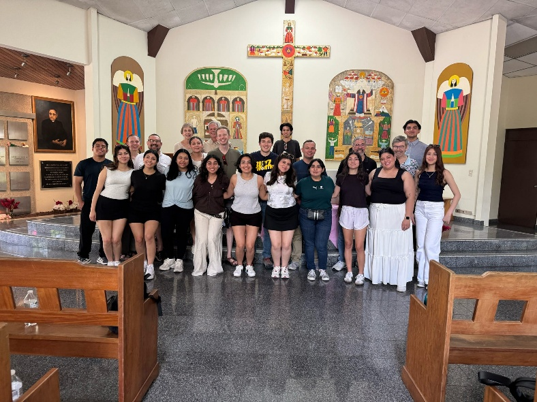
The McMurry group in the chapel at the University of Central America.
Several sites we visited were associated with Archbishop Óscar Romero, who was assassinated on March 24, 1980, while he was consecrating the Elements of Communion. A particularly poignant experience for us was sitting quietly in the chapel and viewing the altar where Romero was standing when the murder occurred.
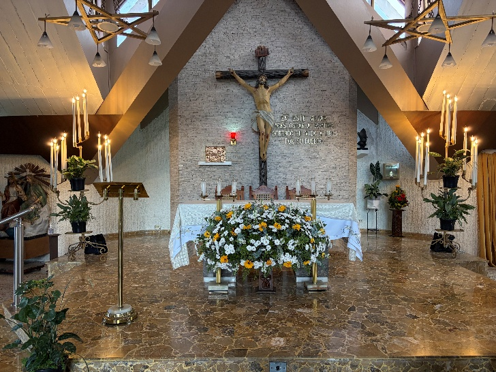
Altar in the chapel of Divine Providence Hospital, the site of Romero’s murder.
Visiting and learning about the small village of El Mozote was a particularly heartbreaking experience. On December 11-12, 1981, just under 1,000 men, women, and children were murdered by 4,000 government troops. Once again, like the murders at UCA, these troops were members of the Atlácatl Battalion, trained and funded by the U.S. The people of this village were no threat to the government or anyone else. They were victims of a scorched earth policy intended to crush counterinsurgency. El Mozote, however, was well known to be neutral. No counterinsurgents were present! The people were slaughtered anyway.
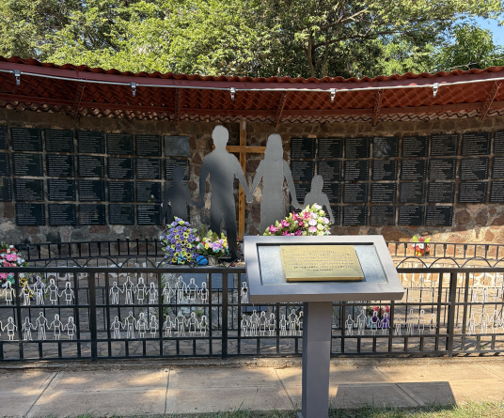
The Memorial Wall at El Mozote with names of the dead inscribed
The experiences I’ve described are a small but significant sample of our spiritual pilgrimage. Each experience, of course, further educated us in Latin American Liberation Theology.
An expression of contextual theology, liberation theology begins with the lived experience of marginalized people rather than beginning with theological or biblical speculation. The Bible remains central but is viewed through the lens of the campesinos who live in crushing poverty.
Recall that one of the first expressions and images of “salvation” in the Bible was not about being saved from personal sins but, rather, being liberated from slavery in Egypt. While it is true that we all sin, reducing the Gospel to personal forgiveness of sin and deliverance from this world is to radically minimize the earthly ministry of Jesus, the revelation of God in Christ, and the grace-filled richness of the fullness of salvation, which incorporates deliverance of entire communities, not just individuals.
Being “saved” from sin can mean that oppressed people are saved from the sins of their oppressors! This is one significant, and overlooked, biblical view of salvation.
A cornerstone biblical passage for liberation theology is Matthew 25: 31-46. Verses 37-40 get to the heart of the matter. The disciples may have been the immediate audience for Jesus’ words here, but the text isn’t clear. Regardless, Jesus spoke of those who fed him when he was hungry, gave water when he was thirsty, welcomed him as a stranger, and so on.
The listeners respond,
Lord, when was it that we saw you hungry and gave you food or thirsty and gave you something to drink? 38 And when was it that we saw you a stranger and welcomed you or naked and gave you clothing? 39 And when was it that we saw you sick or in prison and visited you?’ 40 And the king will answer them, ‘Truly I tell you, just as you did it to one of the least of these brothers and sisters of mine, you did it to me.’
The text teaches that what we do or fail to do for the “least of these” we do to Jesus. Liberation theology suggests, therefore, that the place to find Jesus, to find God’s self-revelation, is in and among the “least of these,” the oppressed and marginalized. This is an example of what is intended above where I wrote, “…liberation theology begins with the lived experience of marginalized people….”
This beginning leads to praxis in which theology is lived out through transformative action that changes unjust circumstances. Without transformative action to change unjust circumstances and systems through peaceful means, it is not liberation theology.
Jesus was marginalized by political and religious power. He was murdered by the state—Rome—with collaboration from some, certainly not all, Jewish leaders.
The oppressed and murdered people in the time leading up to and during El Salvador’s civil war were also murdered by the state. Their suffering reveals Jesus. “Whenever you did it to the least of these, you did it to me.”
The cross of Christ is not just a first century instrument of torture and death; it is the ongoing reality that where people suffer and die unjustly, God is with them in their crucifixion, in their suffering. God is found in “the least of these.”
The divine revelation of the cross is that God suffers with all who suffer. God allows Godself to be the victim of oppressors. God stands in solidarity with the marginalized. But that suffering love is only half of the story.
Beyond suffering is the resurrection, which is manifested daily through the resilience of hurting people and manifested eternally in God’s gift of life that, in the ultimate sense, never fails. God’s gift of life is the gift that keeps on giving. That’s resurrection!
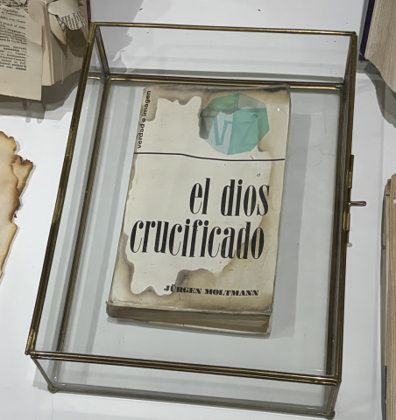
I’ll close with a particularly relevant symbol of our pilgrimage in El Salvador. Pictured below is a Spanish translation of The Crucified God by the late theologian Jürgen Moltmann, a classic theological text on the suffering of God. It is displayed at the Museum of the Martyrs at the University of Central America, the site where the six Jesuit priests, their housekeeper, and her daughter were murdered. The book is stained because it fell in the blood of one of the priests.
The blood-stained book is a book about the suffering of God!
(This article is my personal analysis and does not necessarily reflect the position of my employer.–Mark Waters)
Mark Waters is professor of religion at McMurry University and Dean of the College of Liberal Arts and Education.

