
Keepers of the Cape
Mike Patrick
I had the privilege of teaching hundreds of undergraduate and seminary students from Hardin-Simmons, Abilene Christian, and McMurry Universities over a 20+ year span while serving as Coordinator of Ministry Education at Henrick Medical Center. A few of those students went on to become military chaplains. For example, Commander Alan Rogers, deputy force chaplain for the 12th Marine Corps, San Diego, temporarily left the Navy to obtain his theological degree before returning to the Navy as a chaplain.
A few years later, his daughter, Sarah Greenfield was a ministry student at HSU who became a Navy Lt. Commander chaplain as well (she married the son of Mike and Patti Greenfield of First Baptist, Abilene). She recently completed service as a flag aide assisting Rear Admiral Gregory Todd Chief of Chaplains for the Navy at the Pentagon. Some students also went into the Army, Air Force, or Navy. Others went to serve as chaplains in hospitals and hospices.
As we approach our nation’s 250th anniversary, I want to share a few insights about the early history of military chaplaincy in America. Long before the founding of our nation, men had served in the capacity of chaplains, though they may have had other titles. Legend tells that the term chaplain came from the story of St. Martin of Tours in the 4th century. As a young Roman soldier on a cold winter day, he cut off half of his wool cape with his sword and gave it to a beggar. He dreamed that night that Jesus wore the portion of the cape he had given away. Martin left the military and became a priest. The Latin word cape (“cover with protection”) eventually became chaplain (“keeper of the cape”) in French.
During the Revolutionary War, 220 chaplains served the army and navy, though they had no military training nor uniforms. During regiment inspections, when “present arms” was ordered, the soldiers raised their muskets, but chaplains often raised their Bibles.
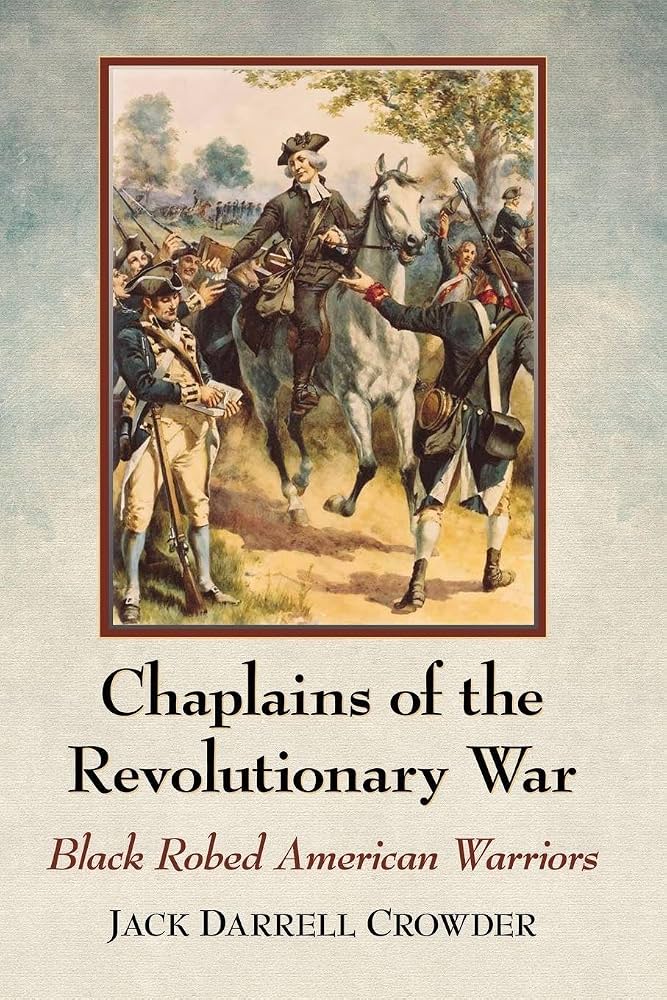
Credit: visualhunt.com Chaplains of the Revolutionary War: Black Robed American Warriors: Crowder, Jack Darrell: 9781476672090
Benjamin Franklin told the story of a “zealous Presbyterian” chaplain serving on the western front of Pennsylvania. The chaplain complained that far too few soldiers were attending prayer services. Franklin responded that “It might be beneath the dignity of your profession to act as steward of the rum. But if you were to deal it out only just after prayers, you might have them all about you.” Franklin later reported that never were prayers more generally and punctually attended.
When George Washington became commander of the Continental Army on July 2, 1775, he found fifteen chaplains among the army’s twenty-three regiments. Soldiers said they would pay out of their own pockets if they could have a chaplain. Washington responded he wanted chaplains appointed and paid by the military. He added chaplains from eight different denominations.
In 1780, he worked out an agreement with his British counterpart that chaplains would not be treated as Prisoners of War, but both sides would release them to return home. No Catholics served in the early wars of our country, but President James Polk visited with several bishops and then he appointed two priests as chaplains in 1846.

Union Chaplain Sullivan Hardy Weston
The Civil War brought new challenges. The Union Army employed nearly 4,000 chaplains from twelve denominations and various ethnic backgrounds. After Congress changed the wording in the legislative language from “Christian denomination” to “religious denomination,” Rabbi Jacob Frankel became the first Jewish chaplain in 1862. Henry M. Turner became the first black army chaplain and served only “colored troupes.” Ordained minister, Ella E. Gibson, received President Lincoln’s reluctant approval as the first female chaplain and was assigned to the First Wisconsin Heavy Artillery. Among the 1,300 Confederate Army chaplains was the first Native American chaplain, Unaguskee, who served the Cherokee soldiers in North Carolina.
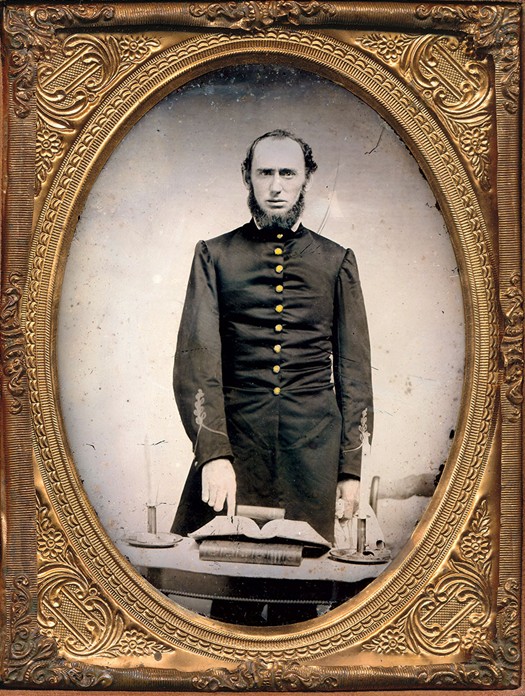
Confederate Chaplain Nick Davis
Because some chaplains were uneducated, unprepared, or unethical, Congress passed the first requirements moving toward denominational endorsement—requiring ordination and oversight. Perhaps due in part to the trauma of war, the “Great Revival” occurred in 1863-64 when thousands of soldiers made professions of faith.
Space does not allow me to share more of this story of God and war in American history. The military establishment continued to make adjustments through the years. Chaplains do not carry weapons but are assigned a chaplain assistant who does. Through the years, about 400 chaplains have died while serving in the military. Today, approximately 3,000 chaplains serve in the Armed Services.
Deuteronomy 20 gives instructions to the Israelites regarding warfare. This chapter underscores a great confidence in God’s leadership, protection, and justice. The passage uniquely meshes the grim realities of war with a deep concern for ethics, humanity, and reverence for God’s creation. The priest [a chaplain of sorts] speaks words of encouragement in verses 2-4:
When you are about to go into battle, the priest shall come forward and address the army. 3 He shall say: “Hear, Israel: Today you are going into battle against your enemies. Do not be fainthearted or afraid; do not panic or be terrified by them. 4 For the Lord your God is the one who goes with you to fight for you against your enemies to give you victory.”
I am grateful for all the men and women who serve as chaplains in the Armed Forces as they continue, among other duties, to give words of encouragement.
Mike Patrick is retired as Chaplain and Ministry Education Coordinator at Hendrick Medical Center

