
Orthodox Pascha is Worth Waiting For
Holy Week Schedule at Saint Luke Orthodox Christian Church, 501 Sunset Drive
April 3: Little Compline with Canon for St. Lazarus, 6 p.m.
April 4: Lazarus Saturday: Hours 9:40 a.m./Divine Liturgy 10 a.m.; 5:30 p.m., Great Vespers for Palm Sunday
April 5: Palm Sunday: 9:00 a.m., Matins; 10 a.m., Divine Liturgy. Lunch follows in the hall; 6 p.m., Bridegroom Matins
April 6: Holy Monday: 6 p.m., Bridegroom Matins
April 7: Holy Tuesday: 6 p.m., Bridegroom Matins
April 8: Holy Wednesday: 6 p.m., Holy Unction4/9: Holy Thursday: 9 a.m., Vesperal Divine Liturgy; 6 p.m., Service of the Twelve Passion Gospels
April 9: Holy Thursday: 9 a.m., Vesperal Divine Liturgy; 6 p.m., Service of the Twelve Passion Gospels
April 10: Holy Friday: 10 a.m., Royal Hours; 3:30 p.m., Great Vespers of Taking Down from the Cross; 6 p.m., Lamentations at the Tomb
April 11: Holy Saturday: 10 a.m., Vesperal Divine Liturgy; 10 p.m., PASCHA Services Begin. (This is the main service of Orthodox Easter.)
April 12: PASCHA, Noon, Agape Vespers
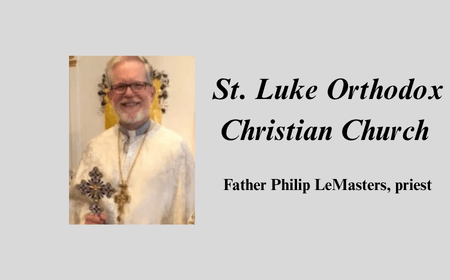
By Philip LeMasters
Eastern Orthodox Christians may hesitate a bit this year on April 5 when friends say, “Happy Easter!” We might respond with “Happy Palm Sunday!” Though Orthodox agree with Catholics and Protestants that Easter is on the first Sunday following the first full moon after the vernal equinox, which is set for these purposes at March 21, things get complicated after that. The Orthodox Church uses the Julian calendar for dates related to Pascha (the most common Orthodox term for the celebration of Christ’s resurrection), which means that March 21 becomes April 3. As well, the ecclesiastical full moon is determined not by modern astronomy, but by lunar cycles that differ from those used by the Western churches. While Orthodox Pascha is often a week or two later than Western Easter, the difference can be up to five weeks. This year, we will celebrate Christ’s resurrection on April 12, only one week after Catholics and Protestants.
The word “Pascha” means “Passover,” which conveys that the risen Christ is our Passover from death to life. Of course, the crucifixion and resurrection occurred in the context of the Jewish Passover. The Orthodox Church views Pascha as the feast of feasts, the high point of the liturgical year that manifests the most fundamental proclamation of the Christian faith: “Christ is risen from the dead, trampling down death by death, and upon those in the tombs bestowing life!” As in Orthodox churches around the world, parishioners at Saint Luke gather late at night in a pitch-black church to await the good news that “Christ is risen!” After processing outside with lit candles, they return to find the church brilliantly illumined and decked out in white. The celebration then continues for at least a couple of hours as congregants sing the joy of the Lord’s victory over death, receive the Eucharist, and exchange the joyful greeting “Christ is risen! Indeed, He is risen!” Then the celebration continues with rich food and celebratory beverages in the parish hall. This is the only night of the year when I may not get home until 3 a.m. Thankfully, the next service of the day is at noon and is brief, at least by Orthodox standards. After that, we have another festive meal and turn in early. After several weeks of intensified spiritual disciplines, including austere fasting, we celebrate the joyful season of Pascha with gusto for forty days.
For Orthodox Christians, Pascha is neither simply an historical remembrance nor a seasonal ritual. It is truly an entrance into the kingdom of heaven and the fulfillment of the human person in God’s image and likeness. Humanity’s slavery to the fear of death, which is the wages of sin, is at the root of our common corruption and misery in the world as we know it. Jesus Christ took the consequences of sin upon Himself, entering fully into death through the cross in order to set us free. Death could not contain Him, however, for He is not merely human, but also divine. When Christ rose victoriously over death on the third day, He brought all the dead up with Him from Sheol (or Hades, the shadowy place of the dead) into the presence of God. The point is not that the Son paid a debt or ransom or somehow satisfied the honor or justice of the Father, but that out of love for suffering humanity, He offered Himself fully in order to make us participants in the eternal life for which He created us in the first place. Eastern Orthodox Christianity has no theory of the atonement, for our liberation from slavery to sin and death is a mystery beyond precise rational definition. The proclamation “Christ is risen! Indeed, He is risen!” gets to the very heart of how it is possible for people to become participants in eternal life and “partakers of the divine nature” (2 Pet. 1:4). Pascha is the great feast of our salvation and well worth waiting for.
Father Philip LeMasters is the pastor of Saint Luke Orthodox Christian Church, 501 Sunset Drive. The parish’s website is www.stlukeorthodox.net. LeMasters also is a professor of religion and director of the Honors Program at McMurry University. For more information, contact St. Luke’s pastor Father Philip LeMasters at frphiliplemasters@gmail.com.


Learning about the intricacies and distinctions among the different faiths is interesting and beneficial as it helps us understand and appreciate each other.
LikeLike