
Meet Mark Waters

By Loretta Fulton
Dr. Mark Waters has been a full-time professor at McMurry University for 19 years, plus six more as an adjunct before that. He has a bachelor’s degree, a master’s and a doctorate.
But he now finds himself in the role of student, not teacher. He recently was named Dean of the College of Liberal Arts and Education.
“I recognize that I have a lot to learn about this new role,” he said. “The students, faculty, and staff of McMurry University are my teachers.”
Waters will share his responsibilities with Associate Dean David Amlung, who is an associate professor of music. Together, they will oversee 12 departments, while the chairperson of each department will have director administrative responsibilities.
With the addition of new responsibilities, Waters will teach one course per semester, including the honors section of Religions of the World in the fall. While he is teaching, Waters will also be learning from the entire McMurry community.
“I am confident I will continue to learn much from them,” he said.
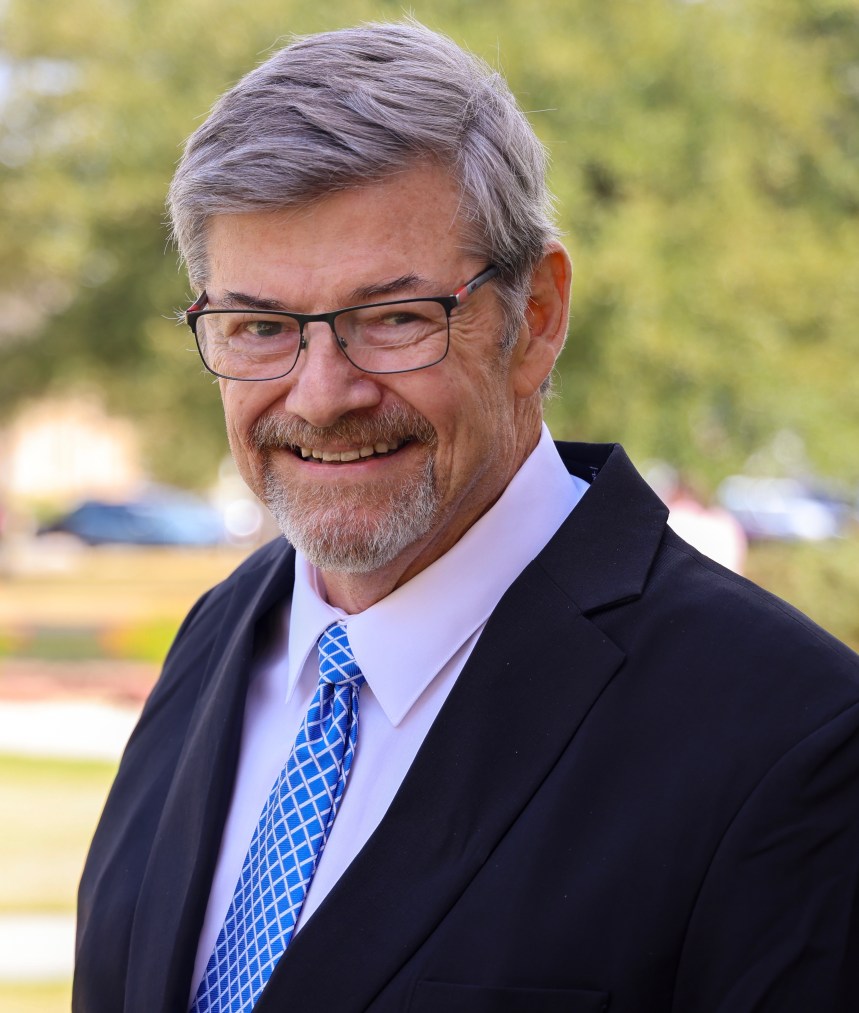
Mark Waters
Place of birth: Lubbock, Texas
Where you grew up: Lubbock, Texas
Family: Krista, Michael, Amelia, and Juliet Mayerich; Becca and Alavehy Ellery
Education: Ph.D. (‘91) and MDiv (’84), Southern Baptist Theological Seminary; BA (’80), Texas Tech University. (For the sake of McMurry’s academic reputation as well as my own, it is necessary to provide some background about Southern Seminary. Prior to the completion of the fundamentalist takeover of the Southern Baptist Convention and the termination of most of Southern Seminary’s faculty in the mid-1990s, the Seminary’s Ph.D. program was highly respected with an academic reputation only slightly below the Ivy League divinity schools. The various master’s degree programs were, likewise, well respected. This level of excellence was especially prominent in light of the strong faculty from the 1970s until terminations began in the mid-‘90s.)
Years at McMurry: 19 years full-time plus six prior years as an adjunct.
Positions held: Adjunct Instructor, Assistant Professor, Associate Professor, Professor, Director of the Servant Leadership Program, Director of International Education, Interim Chaplain, Chair of the Division of Humanities, Religion, and Social Sciences, Dean of Liberal Arts and Education.
Previous (relevant) positions: Pastor of four churches over a period of seventeen years and Executive Director of a faith-based nonprofit (Just People, Inc.)
Community involvement: The Episcopal Church of the Heavenly Rest, the Abilene Interfaith Council, occasional preaching and teaching in various congregations.
Q You recently were named Dean of the College of Liberal Arts and Education. Will your teaching load be reduced? What courses will you teach in the fall?
A Yes, my teaching load will be reduced. With possible exceptions, I will teach one course per semester. I will teach the honors section of Religions of the World in the fall.
Q What are your responsibilities as dean?
A Associate Dean Dr. David Amlung and I will be the overall administrators for twelve departments. The chairperson of each department, of course, will have direct administrative responsibilities. The departments include Art & Design, Communication Studies, Curriculum and Instruction, English, History, Music, Political Science, Religion & Philosophy, Servant Leadership, Sociology & Criminology, Spanish Studies, and Theatre. Additional responsibilities include (a) aligning academic programming with workforce trends, job readiness, and student success metrics including assessment, (b) serving on the Dean’s Council and the Academic Cabinet, (c) supporting the faculty, already quite strong, in continuous development and improvement, (d) leading with vision and innovation, (e) serving as an advocate for liberal arts and education within the university and in the community, and (f) representing the college and the university in the community.
A word about advocacy for the liberal arts and education: Advocacy begins with a description of the nature of liberal arts, which many people seem to misunderstand. It has nothing to do with the way the word “liberal” is used in contemporary politics. Liberal arts have a long history. Although Cicero (106-43 BCE) later popularized the term artes liberales (arts of a free person—liberum is Latin for free), Plato (ca. 428-348 BCE) previously laid the foundation by emphasizing enkyklios paideia, a “well-rounded education” deployed in the contemporary concept of general education. In other words, the liberal arts are intended to provide skills that prepare people for life and good citizenship in a free (liberum) society, not just a job.
With reference to job readiness, the liberal arts cultivate skills that are necessary for any job including, but not limited to, critical thinking, creative thinking, creativity, oral communication, written communication, teamwork, leadership, social understanding, cultural awareness, religious literacy, and more. A university education includes but transcends acquiring specific technical skills for a particular job. STEM and preprofessional education are important. I’m not demeaning these areas at all. But, unfortunately, over the last few decades these areas of study have eclipsed liberal arts. In general terms, STEM and preprofessional training give students excellent skills for specific jobs. This is good but does not account for the fact that most young adults will change careers three or four times over the course of their lifetimes. Liberal arts provide skills that, as already noted, are necessary for any job and necessary for thriving in life itself.
While there is no “official” list of liberal arts courses, lists tend to include: Humanities (Philosophy, Religion / Religious Studies, History, Literature, Languages, Linguistics, Education), Social Sciences (Sociology, Psychology, Anthropology, Economics, Political Science), and Creative and Fine Arts (Visual Arts, Music, Theatre/Drama, Dance, Film & Media Arts, Art History, Creative Writing, Design). Natural Sciences, Mathematics, Psychology, and Economics are liberal arts too, but categorized differently at McMurry for practical, not inherent, reasons.
Q Do you plan to make any changes to the structure of the College of Liberal Arts and Education?
A We will begin by developing a clear vision and mission for the College crafted to be consistent with the University’s core values and mission. The core values are Christian faith as the Foundation of Life; Personal relationships as the Catalyst for Life; Learning as the Journey of Life; Excellence as the Goal of Life; and Service as the Measure of Life. The mission is: “Shaped by Christian principles, McMurry University challenges students to examine our complex world from multiple perspectives in preparation for lives of leadership, service, and professional success.”
Since the College of Liberal Arts and Education is less than two months old at this point, I am hesitant to name any changes until we clarify our vision and mission in the context of that of the University.
Q You have taught at McMurry for 19 years. What has remained the same with students over the years?
A The most notable phenomena that has remained the same is the transformation that many if not most students experience between their first year and their senior year. Some students enter college without having engaged intellectually or relationally with others who hold significantly different worldviews or lifestyles than their own. In many cases, it is not that first year students are closed to others or resistant to difference (though some are), they simply haven’t experienced these kinds of differences personally.
For example, one of my courses is Religions of the World. I’m very clear with students that I am not trying to change anyone’s religious views, but rather to help them to understand views, practices, and lifestyles that are different than their own. There is a significant difference between being aware of difference and truly understanding. I remind students of the Golden Rule that is present in various words in numerous religions, “Do to others what you would have them do to you.” Then I ask, “Would you rather someone evaluate or judge your religion if they understand it sufficiently, or if they are operating out of stereotype and prejudice?” The obvious answer for most is that they prefer that another person would genuinely understand them before evaluating or judging them. So, I add that if we are to “do to others as we want them to do to us” we, likewise, need to understand their religion before making any determinations about that religion or that person as an individual. The goal of the class is never to convert but, rather, to understand. I recognize that total understanding of another person is virtually impossible, but a general understanding vs. stereotype is crucial.
This principle applies to all the differences students discover after they get to college. I had a student a number of years ago who grew up in a small town and had never met an African American before coming to McMurry. Hard to believe, I know. To his credit, his views of African Americans were not really prejudicial, just nonexistent. He graduated from college four years later as one of the most accepting students I’ve known. He became open toward all kinds of differences, not just race, that he never encountered in his small hometown.
This exposure to and acceptance of difference is not just relational, it is conceptual. Students evolve by being exposed to different and competing ideas and theories. In this regard, I highly value McMurry’s mission statement which includes the phrase “McMurry University challenges students to examine our complex world from multiple perspectives.” To be clear, this transformation is not about indoctrination. I do not force ideas on students. Rather, I help them to understand multiple perspectives and to develop the critical thinking tools to decide for themselves.
So, in terms of what hasn’t changed, the college experience tends to be transformative regarding views and biases toward others who are different in any number of ways from oneself. This is one of the reasons that I get tears in my eyes during commencement ceremonies. I watch students whom I’ve known for four years or more, remember what they were like as freshmen, and become deeply moved by the adults they have become. More generally, something that hasn’t changed is that, if students take full advantage of the college experience, they grow from adolescent developmental stages into adults. A college education is partly about “adulting.” This hasn’t changed since I came to McMurry almost twenty years ago.
Q You have led or accompanied student groups to other countries throughout your teaching career. How has that experience shaped what and how you teach?
A These service trips, academic trips, and spiritual pilgrimages consistently demonstrate something I have believed for a long time: Learning becomes practical and realistic through experiences and exposure to difference, not just the addition of knowledge to one’s mental filing cabinet. I try to include relevant experiences in the way that I teach. Even when opportunities are limited outside the classroom, I attempt to connect the learning of facts and concepts with their application in real life. In other words, I try to create experiences that help students to answer a question we’ve all asked at some point in time, “Why do I have to learn this stuff?”
Q For many students, those trips are the first time for them to visit another country. What is the most significant enlightenment they experience?
A Although an adequate response to this question would need to come from each student, I would say that one of the most significant “enlightenments” that tends to apply to every student is a new understanding of the similarities and differences in the human family. First, students tend to learn that these people who may have seemed so “foreign” before meeting them are actually “just like me” in many ways with similar needs, dreams, disappointments, and hopes. Second, the students (as well as all of us who travel) learn to appreciate and respect differences rather than prejudge or fear them. Experiencing similarities and differences tends to dissolve the prejudgments, stereotypes, and implicit biases that we tend to carry until we learn better. The book title Same Kind of Difference as Me comes to mind

Loretta Fulton is creator and editor of Spirit of Abilene


Congratulations on your new appointment. I’m sure you will do a great job.
LikeLike