
The Woman Who Said ‘No’
Editor’s Note: This is part of a series of articles highlighting inspirational women during Women’s History Month. Click on the links below for related stories:
Meet Virginia Henderson Yates by Marianne Wood
The Black Gazelle by Danny Minton
Omie Wilks, A Hidden Life by Darryl Tippens
Sarah Mullally, the 106th, but 1st Female, Archbishop of Canterbury by Rev. Mary Glover
By Danny Minton
Sometimes we come across people who are well-known in certain circles but unknown to most. One such person I heard about recently was Dr. Frances Oldham Kelsey. Dr. Kelsey passed away in 2015 at the age of 101. Her career included working for the FDA from 1960 until she retired at 90, 45 years later.
Dr. Kelsey was named head of the NDA (New Drug Applications) division. Her second assignment came in September of 1960 when a Cincinnati company, Richardson-Merrell, requested approval for a sedative called Kevadon, the US tradename for Thalidomide. At this time, the NDA had 60 days to approve a drug, or the company could proceed with marketing. At the same time, drug companies could distribute samples of the drugs marked ‘experimental’ to doctors’ offices. The drug was on the market in the UK, Europe, Australia, West Germany, and Japan as a choice for insomnia and was safe for children and women with morning sickness during pregnancy.
Richardson-Merrell expected the drug to be approved and planned to launch the product in the US six months later. However, Dr. Kelsey and her team found insufficient evidence regarding the drug and denied approval. The company was angry about the denial since the drug was already in wide use in other countries. They applied again, and again Dr. Kelsey and her group said, “No.” The drug company visited the NDA as many as 50 times over the next 18 months with aggressive tones, trying to get the drug approved.
It was then that reports began coming in from other countries. Children were born with deformed and missing limbs. The link was to the drug called Thalidomide. Eventually, over 10,000 cases of birth defects were reported in the countries that were already using the drug. Dr. Kelsey and her team had saved the possibility of thousands of babies in the US being born with the same problems by continuing to say “No,” due to the lack of supportive evidence of the drug’s safety. In 1962, Richardson-Merrill withdrew its application. The drug is used today as effective for certain forms of skin cancer, but is highly regulated and not used on women who are pregnant or expect to have children. President Kennedy would later award Dr. Kelsey the “President’s Medal of Service.”
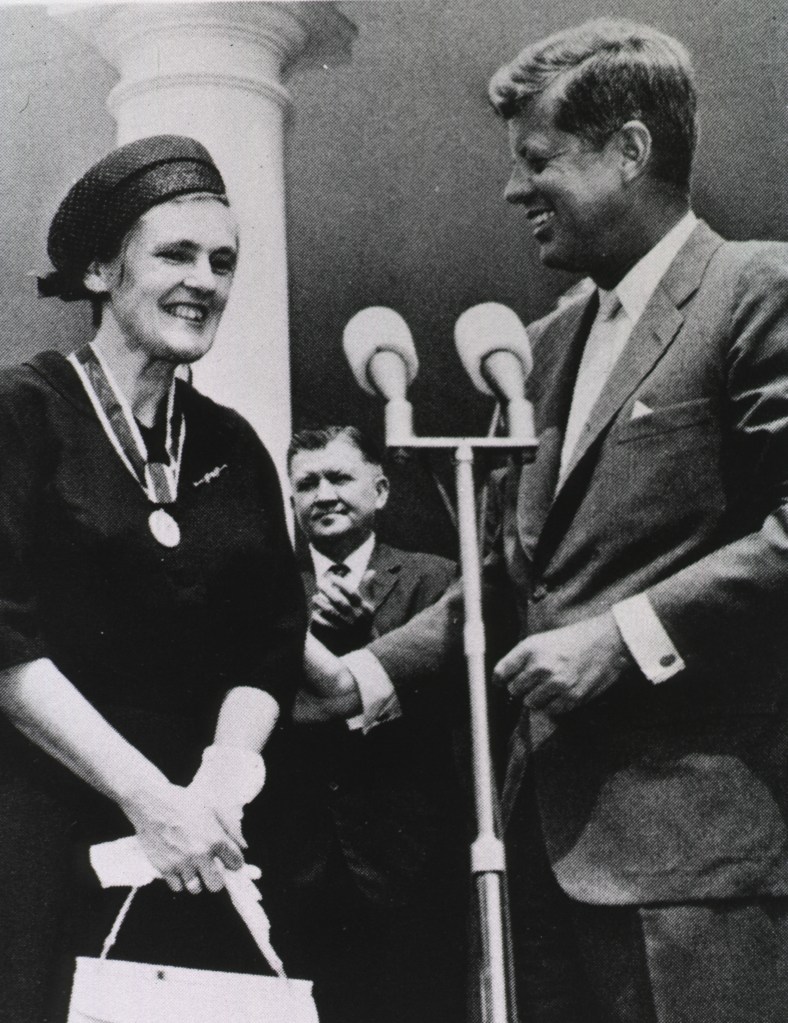
Frances Kathleen Oldham Kelsey receiving the President’s Award for Distinguished Federal Civilian Service from President John F. Kennedy, in 1962.
There are times in life when many of us face challenges and pressure from others to make decisions without knowing all the facts. It’s difficult to stand up against the crowd trying to pull you in a direction you don’t feel is the right thing to do. It takes courage to stand up for what you believe is the right thing to do. Frances Kelsey and her team faced significant pressure but stood by their decision until they were sure all the information was correct.
Learning to wait and gather all the facts is contrary to how most people react. However, learning to be patient and gather all the information you need before deciding whether something is right or wrong will help you make wiser choices in your life. Sometimes we just have to say “No” until we are sure of the right step to take.
Danny Minton, a member of Southern Hills Church of Christ, is a hospital chaplain
 Spirit Of Abilene
Thanks for the tribute to such a courageous woman. It is very difficult to take a position against a popular belief.
LikeLike