
Omie Wilks, A Hidden Life

Editor’s Note: This is part of a series of articles highlighting inspirational women during Women’s History Month. Click on the links below for related stories:
The Black Gazelle by Danny Minton
Meet Virginia Henderson Yates by Marianne Wood
By Darryl Tippens
“I am sure that the old woman who lived in the little house at Golders Green, and was kind to the children and the dogs, will be more known in Heaven than Napoleon or Julius Caesar.”—C. S. Lewis, Letter to Arthur Greeves
As I walked through the half-acre cemetery south of my hometown along Highway 54, it struck me that everybody ought to have at least one Omie in their life. We had just buried her on that crisp November afternoon. The red dirt was still fresh. Yet I knew she could never be far from me. Even now I can see her in that dim, hushed house next door when I was a boy, talking to me as no other grown person ever had. It humbles me to think how much I was changed by those conversations in her living room and kitchen more than half a century ago.
Clara Ethel Norman Wilks—widow, gardener, churchwoman, and next-door neighbor—changed my life. Folks today might say she was my “intergenerational mentor.” For me she was just Omie.
I grew up on her cookies and her counsel. I mowed her yard, drove her to church, and after her kindly husband, whom everyone called Papa, died suddenly, I sometimes slept in her big two-story house next door because she was afraid to stay alone. It did not seem strange then—a boy keeping company with an old woman. Only later did I understand how rare and consequential those hours were.
Omie always greeted me with a friendly hello when I would check on her, almost as if I were her own grandson. We would sit together and talk while the grandfather clock ticked in the dining room and the little gold anniversary clock turned beneath its glass dome. Photographs lined the walls: kinfolk scattered across Texas, Arkansas, Kansas, and Oklahoma. I was especially drawn to the sepia portrait of her youngest child, Corporal Gorman Wilks, handsome in his Army Air Corps uniform just like my father used to wear, killed in a training flight over England in 1944—eleven days shy of twenty-four. His steady, unchanging smile watched over me as we talked.
I loved Omie’s house, just beyond our peach orchard and the Paradise tree. It was a kind of time capsule that had a paradoxical effect on me—it planted dreams in me. Nothing in the house was new, but everything was cared for and tidy, as though the objects themselves were companions from her past. It smelled of wood polish and old books. Some of the furniture had come from Sullivan County, Missouri, when her parents, Uriah and Sarah Elizabeth, and older brother Evan Edgar came West in 1894 when Oklahoma Territory opened for settlement. I sometimes slept in the towering pre-Civil-War bed, that made the trek with them, its mattress stretched across thick ropes pulled tight on wooden pegs. Lying there, replaying the old woman’s stories in my head, I imagined lost centuries and distant lands.
Omie’s stories were alive with detail. She told me about how a group of nine Missouri families, including Omie’s, traveled by train as far as Minco, an outpost in Indian Territory, then crossed the prairie by wagon and foot. As she talked, I could see the ocean of prairie grass that lay before her; how the bluestem stood shoulder-high as she walked through Cheyenne Arapaho lands; how there were no fences, no trees, no roads before them—only sky and sun and wind and possibility; how the nine families settled together on adjacent plots of land just north of Seger Colony—the site of a famous Indian school where I would one day live and gather my first indelible memories.
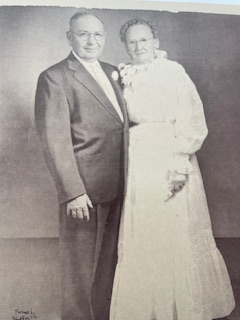
Clara “Omie” Wilks with her husband, L.O. “Papa” Wilks, on their 50th wedding anniversary in 1954
Omie was my link to a world passing away. Born in the administration of Grover Cleveland, twenty years after the Civil War ended, she was thirty-five when she got the right to vote. She belonged to a church that was steadfastly prohibitionist—no alcohol, no dancing, no movies (at least not on Sundays). She once told me she thought bowling alleys were dubious establishments. “Have you noticed they don’t have windows?” she said. But she was no Puritan. There was joy in her life. She grew up in a profoundly social world of picnics on the ground, Fourth of July parades, settlers’ reunions, family gatherings, church singings, and revivals. Her world was fading, true. Yet, strangely, her stories gave birth to something new and exciting in me.
Omie was a first-rate gardener. She planted tomatoes and beans and peas, and she planted something else in me: a love of faraway places, of spiritual adventure, and of Christian education. She corresponded with missionaries all over the world, and she told me about their adventures. These accounts planted a keen interest in me. She talked to me about Europe and Africa as if they were just beyond the garden gate. I too wanted to see Brazil and Italy and Israel. Though she had little schooling herself, Omie loved Christian colleges and knew a lot about them. Her enthusiasm was contagious. I planned to go to a state college, but she thought a Christian college would be better. “You could go,” she said more than once, as if naming a simple fact. “I’d help you,” she said. My parents were not so sure, given the considerable cost. But Omie was sure.
Looking back, I see what happened to me in that old house. Her vision took hold of me. She carried me beyond myself. She may have looked provincial, but Omie made the world larger than my small town and my small expectations. In her presence, the future felt possible. Because of her, I attended a Christian college, which led to a fulfilling career in higher education I could never have guessed.
On my last visit, Omie invited me to sit with her in the front room and talk about my life. Small and bent, she looked as she always had—thin lips set in firm resolve, high forehead lined and freckled by sun and time, slender fingers brushing her forehead as she spoke. She had lived long enough to see most things twice, yet her interest wasn’t in the past, but in me, how my studies were going and what I might do with my life. I told her how much I loved literature and wanted to teach someday. She gave me what would be her final charge: love God, serve others.
Omie died the year I finished my Ph.D. She never lived to see what became of me. She never met my students, never visited the universities where I taught, never read anything I wrote, never learned of the foreign countries where I would teach and lecture. But I don’t think she would have been surprised. She had already envisioned what I could do.
Clara Norman Wilks lived what the novelist George Eliot called “a hidden life.” She never captured the headlines. Her domain of family, church, and neighborhood was narrow by most people’s estimation. She grew up in a culture that never invited her to teach, preach, or lead. Yet she taught me. She led me. Her life spoke plainly and powerfully to me. We live in a better world, Eliot observed in Middlemarch, “half owing to the number who lived faithfully a hidden life, and rest in unvisited tombs.” Eliot was imagining people like Omie, I think.
Last May, on my birthday, I made a pilgrimage to Omie’s grave. There I remembered her stories and reflected on the ways she had nurtured me and believed in what I could become. She had been my neighbor, my friend, my mentor. And more.
Recently, while tracing my family tree, I stumbled onto something I never expected. Nine generations back stood Jonathan and Jane Prather, my ancestral grandparents in Colonial Maryland. I paused over their names, then began to trace the ancestral lineage of their two sons, Thomas and John. Thomas’s thread led to me. John’s line led to Omie. It dawned on me: Jonathan and Jane Prather were Omie’s great-grandparents too. The old woman who lived next door, who had opened the past to me and taught me to see how lives stretch across time and distance, was not only my neighbor. She was my kin—my eighth cousin, twice removed. It astonished me to learn, so many years later, that the one who taught me about the mysterious threads binding lives together had been bound to mine all along.
Darryl Tippens is retired University Distinguished Scholar at Abilene Christian University
 Spirit Of Abilene
A beautiful piece.
LikeLike
I was so delighted to have another part of the Darryl Tippens life story presented in his own words. Since Darryl guided my life in many ways, I feel the special connection to Omie very keenly. With love and thanks to Omie and to DLT. ♥️
LikeLike
What a wonderfully rich relationship! You and she were truly blessed.
LikeLike
Everyone should have an Omie Wilks in their life story!
LikeLike