
The Black Gazelle

By Danny Minton
When she stepped on the track at Abilene Christian College in July of 1960 for the Olympic trials, her high school coach in Tennessee had given her the nickname “Skeeter” because she was so fast. When the trials were over, she had set the world record in the women’s 200m race, a time which would stand for eight years. Her name was Wilma Rudolph.
Wilma Rudolph would go on to make history in the world of women’s track. Along the way, she would claim several more nicknames in the sports field. Known as “The Track Star,” she would be called “The Flash,” the newspapers labeled her “The Tornado,” The French called her “The Black Pearl” and “The Chattanooga Choo-Choo,” and after winning three gold medals in the Olympics, she was crowned by the Italians with the name, “The Black Gazelle.” But when we turn back the years of history, we find a story of an unlikely athlete, one who at one time was told that she’d never walk normally, much less run.
Born prematurely at 4.5 pounds in June of 1940, she was the 20th child in a family of 22. Her father was a railway porter and her mother a maid in the town of Saint Bethlehem, Tennessee. As a child, she battled pneumonia, scarlet fever, and at 5 years old contracted polio, causing infantile paralysis and the loss of full use of her left leg and foot. It was then that she was fitted with a leg brace and faced a life of disability.
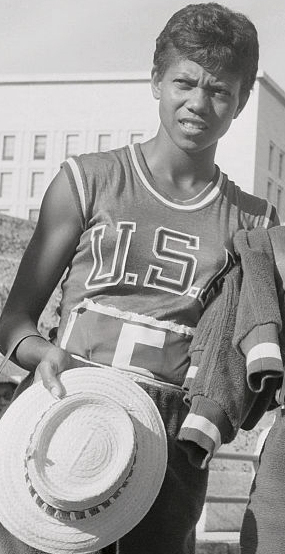
There was nothing available in the 1940s in the Saint Bethlehem or Clarksville area for the treatment of African Americans, so her mother had to drive her 50 miles and back twice a week for two years to facilities in Nashville for treatments. At home, different family members would take turns massaging and working with her leg and foot. At 12 years old, she took the brace off, partly due to teasing at school, her strong desire to walk without it, and all the work her family had put into strengthening her leg.
At Burt High School in Clarksville, she began playing basketball and running track. Track was mostly to keep in shape for basketball, where she set the record by scoring 803 points in her sophomore year. It was there that Tennessee State’s track and field coach spotted Wilma and invited the 14-year-old to be a part of his summer training program. At the age of 16, she became the youngest member of the U.S. Olympic Track Team. She lost her 200m race but won a bronze with the 4x100m relay. At the 1960 Olympics, she would win gold in the 100m, 200m, and 4x100m relay, becoming the first African American woman to win three gold medals at one Olympics.
Returning home, the governor of Tennessee, Buford Ellington, planned a parade and celebration to honor Wilma as a hometown champion. However, Ellington was a segregationist, and Wilma refused to be a part of her celebration since the celebration was segregated. As a result, the parade and celebration plans were changed and became integrated, with thousands lining the streets and over a thousand blacks and whites attending the banquet.
Wilma Rudolph would retire from track, become a teacher and coach, and spend the rest of her life aiding causes that furthered civil rights. In 1963, she participated in a protest in Clarksville against the segregation of city restaurants. It wouldn’t be long before the mayor of Clarksville proclaimed that all city facilities would become completely integrated.
Wilma would die of cancer at the age of 54 in July 1994. Wilma received numerous honors both during her lifetime and for years after her death.
The one thing that stands out goes back to that little girl of 12 who took off that brace and never looked back. She showed courage in becoming what others had said would never happen. She showed courage in standing up for the black community, willing to give up going to a personal celebration because it was segregated. She showed courage in a time when the country was in the darkness of a segregated society.
Paul once said, “I can do all things through Christ who gives me strength.” It’s about courage. Courage to stand up against those things that are wrong and stand up for the good. Wilma Rudolph was a woman who used her abilities to change the world around her. It all began when that little girl took off her brace and ran.
Danny Minton, a member of Southern Hills Church of Christ, is a hospital chaplain
 Spirit Of Abilene
Pingback: Omie Wilks, A Hidden Life | Spirit Of Abilene
I am in awe of such strong, committed people. It’s amazing that she accomplished so much in such a short life.
LikeLike