
Bombs Away

By Jim Nichols
Patriotism levels ebb and flow with many of us. When we watch what seem to be bizarre and wrongheaded statements and deeds reflecting it, we sometimes become cynical and critical. At other times, for instance Independence Day, pride in the country takes on a much brighter side for us. Frequently, an individual swings back and forth through these anti-patriotic and patriotic emotions.
My father was a soldier, as were many young men in 1943. Fresh out of college, he had joined the Army Air Corps as it was called then. I do not know what patriotic thoughts he had at the time. As I came to know him, he seemed reasonably patriotic but mostly expressed that the war was on and he felt responsibility to aid in it. I never sensed any particular pleasure he had in that part of his life—mostly straightforward acceptance.
He kept a written record of those times. Reading snatches of it describe a world that you and I might have difficulty living in today, but his descriptions of almost matter-of-fact aspects of it continue to produce thoughtfulness.
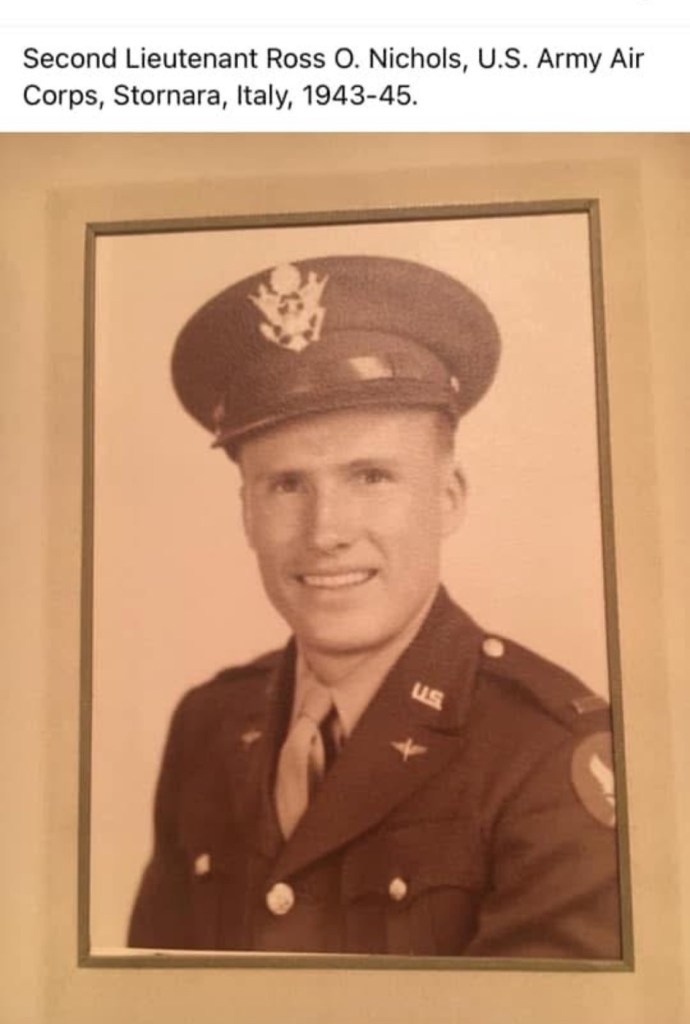
I mentioned in a previous article that he left the U.S. on Christmas Day, 1943, for Naples, Italy. Italy had recently swung from alliance with Germany to alliance with the Allies and was an active staging and battleground area. Within a month, Allies had invaded at Anzio midway up the “Italian boot” with the beginning of an elongated move north to liberate Rome from the Axis troops.
My father was part of the ground support in a group destined to establish an inland airbase for B-24 bombers, each with a crew of ten. My edited notes from him continue.
Jan. 18, 1944: Dropped anchor in Naples bay at noon. Bay crowded with all types of ships. Tankers and troopships unloaded first. Since our ship carried mostly supplies and few troops, we sat in the bay for several days and worried about the German planes finding us and attacking.
Jan. 21: Finally got on land. Naples dock section badly bombed. By truck through Naples to an abandoned college campus. Slept on marble floors in the building. Issued two more blankets and needed them.
His group then started by truck to the proposed airbase at Stornaro.
Jan. 24: Truck I was on broke down and we stopped for one hour. Later we became lost and took the wrong road out of Foggia. Driver admitted he was lost. Nearly ran off the end of a bombed-out bridge. Men stayed at Italian barracks, I at casual officers hotel. Town badly battered.
All this area had been consistently bombed in advance by the Allies.
Jan. 25: On to Cerignola in the morning in the truck and hit a peasant cart but no damage. Out to base near Stornaro. Nothing but landing strip made of metal plates. Tents being pitched, no heat, no lights, no water, no sanitation.
Jan. 31: three cooks and another boy sent to hospital with burns as tent burns down.
Feb. 1: Flying crews plus their ten planes arrive.
Feb. 10: Things getting better. Have latrines, oven gasoline stove, and electric lights. First mission was a dud. No bombs dropped. Visibility nil.
Feb. 17: second mission. Bombs dropped on town in support of beach head. Lt. Johnson’s plane shot down by flack. No one out. Planes down to nine now.
March 2: Good weather. Mission to support Angio beach head south of Rome. No casualties for us but one plane lost an engine. At a base next to ours a plane with controls damaged cracked up on landing. Two men left in the plane which burned. One other taken off dead and another one died while being treated. Squadron bombardier escaped in the landing. Five men parachuted out earlier.
March 9: Received back a letter I sent to Lt. Eric Webb in England marked “MISSING IN ACTION.” (This was one of my father’s friends in training.)
March 12: Attended church in tin hut across from mess hall. Rain continually. Strange to sit in a hut during church services and see on one board a chart of the number of missions/man. On another wall a map showing location and strength of German fighter units. On other wall maps of targets and bombing runs.
This final entry depicts a scene that is striking. They are worshiping in a setting decorated with words of death, destruction, and heroism. Somehow here near Independence Day we might or might not feel a patriotism conflict. In a different setting in scripture, the followers of Jesus said, “This is a hard saying.”
Jim Nichols is a retired Abilene Christian University biology professor and current hospital chaplain
 Spirit Of Abilene
Very touching piece! A few years ago, I typed up all the handwritten diaries from several soldiers in WWII (for the 12th Armored Division Museum in Abilene). I felt as if I knew these young men, mostly kids, as I read their personal thoughts to their families here in the States. Their doggedness amazes me and makes me proud. At the same time, I don’t always feel that pride in what our country does.
LikeLike