
The Notre-Dame Effect: What’s a Cathedral For?

By Darryl Tippens
The Cathedral of Notre-Dame officially reopened on December 8, after a five-year reconstruction marathon involving hundreds of architects, carpenters, stonemasons, engineers, and countless others. The massive project was funded by 340,000 donors from around the world. The restored “masterpiece of faith and Christian architecture,” as Pope Francis described it, would have seemed impossible in April 2019 when it went up in flames.
Firefighters at the time said that when the fire was finally put down the structure was only 15 to 30 minutes away from complete destruction. But today, cleansed of centuries of soot and dust, the Cathédrale Notre-Dame de Paris stands resplendent and pristine, a shining witness to humanity’s capacity to take something utterly broken and make it boldly beautiful again.
It’s worth reflecting on the meaning of the church’s restoration and the reasons for the worldwide devotion to this iconic structure. Why all the attention? Candidly, we might ask: What is Notre-Dame for?
While Notre-Dame is considered many things—“a mirror of the soul of France,” architectural wonder, iconic landmark, and popular tourist destination—it is first and foremost a sacred space. In his letter read at the opening ceremony on December 8, Pope Francis reminded the “Dear faithful of Paris and France” that Notre-Dame is, above all, a house of worship, which “our Heavenly Father inhabits.”
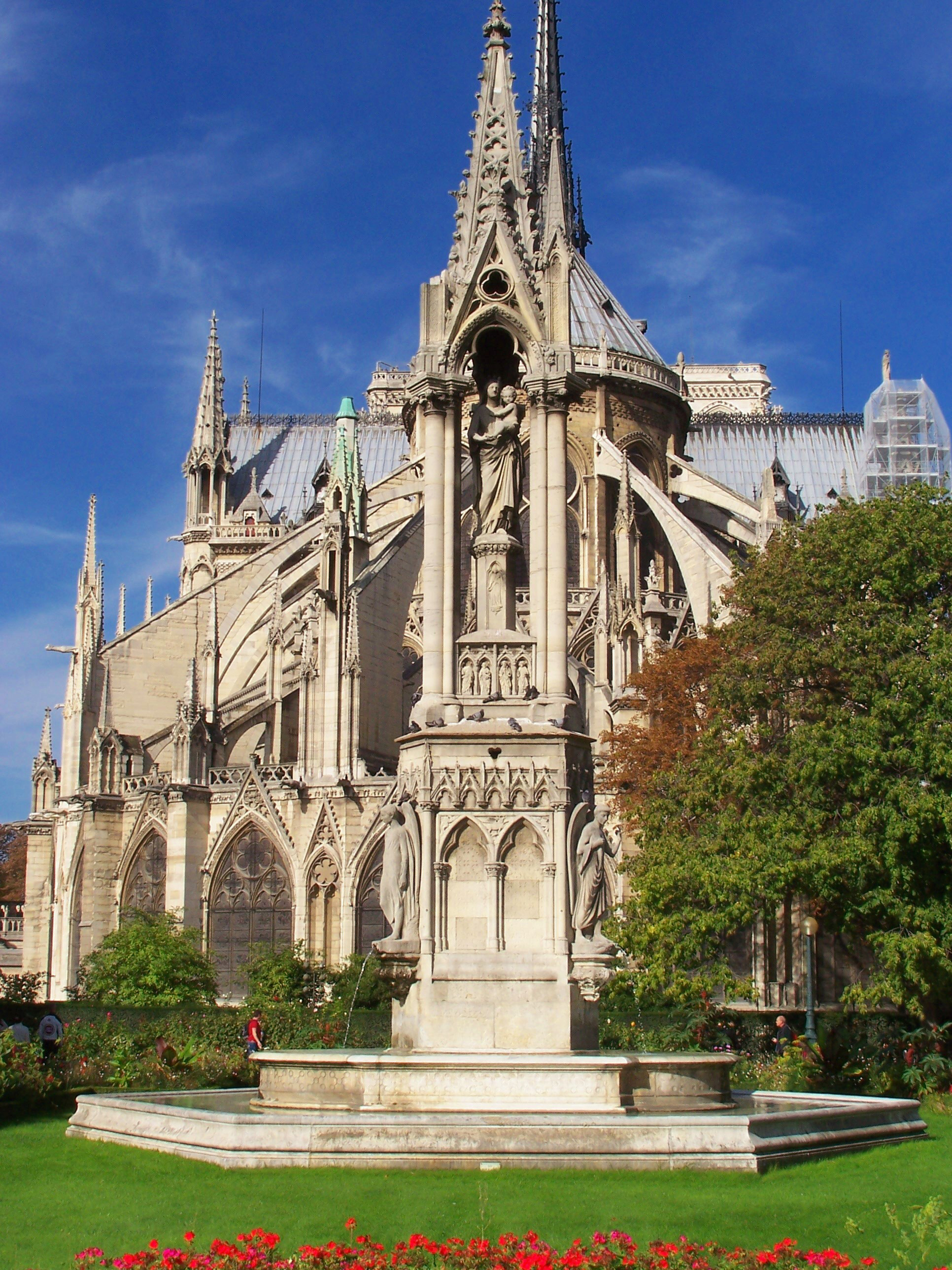
Notre-Dame is a place where something extraordinary can happen to you. Author A. M. Clark, in describing another church near Notre-Dame, Sainte-Chapelle, offers an excellent summary of how an extremely beautiful church can affect a person:
“[The church] operates not just on the visitor’s mind, but their body. Standing inside . . . we become part of its work. The light reflects off our retinas and our skin, and the divine glory it’s designed to harness and illustrate permeates us, in a way that’s tangible. . . . It’s as if we’ve crossed a border from earthly realities into some glimpse of the heavenly realm.”
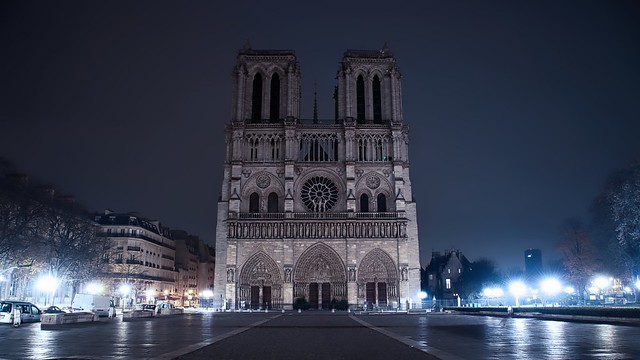
In other words, it’s a “whole body” experience. The aesthetic wonder of Notre-Dame is inescapable, affecting all the senses, not just sight and sound and touch, but even taste and smell in incense, votive candles, and Holy Eucharist. Those who enter are reminded of their proper place in the scheme of things. The gleaming limestone arches, the flying buttresses, the Gothic towers, the storied windows, the massive 8,000-pipe organ, and the sky-piercing spire affect us in ways no photo can capture. The sublime dimensions “resize” you, says contemporary composer Matt Redman. You feel your smallness. You gaze upward and inward.
Material things speak spiritual truths in Notre-Dame. The structure functions like a sacrament, an outward sign of an inward grace, a window opening on an invisible reality. A small shard of colored glass illuminates a sacred story in a rose window. A metal cylinder declares glorious news through a pipe organ. A gnarly gargoyle and the soaring spire join together to say, “Here heaven and earth meet.”
On that fateful day in 2019, the copper rooster atop the spire plummeted into a street gutter, falling just outside the main fire zone. Though buried in ash and debris, it was found, surprisingly intact. Chief Architect Philippe Villaneuve saw in the artifact’s survival “a ray of light in a catastrophe,” a sign that “not all is lost.” A new golden rooster, now perched high above the cathedral, signals new hope after the fiery destruction.
The rooster is perhaps the least understood of the cathedral’s many rich Christian symbols. Americans who think that weathercocks belong on barn roofs may need a tutorial here. Since the earliest days of the faith, the rooster, the herald of the dawn, has stood as a sign of new life and resurrection. In the sixth century Pope Gregory I called the rooster, the symbol of light, “the most suitable emblem of Christianity.” A later pope required that likenesses of roosters be placed on all churches. Thus, roosters sit atop church spires all over the world today, as they have for centuries.
Life seems darker and more unsettled today than it was five years ago when the fire nearly destroyed the cathedral. In a world riven by conflict and despair, the restored Cathedral of Notre-Dame shines like a beacon in the darkness. In France there is talk of the “Notre-Dame effect.” The term denotes a new spirit emerging among the country’s youth, an enthusiasm ignited by the cathedral’s rebirth. Those touched by the “Notre-Dame effect” want to learn the traditional crafts like those used to restore the cathedral. They express a new air of resilience and optimism.
Two hundred years ago the Cathedral of Notre-Dame was in serious decay. But then Victor Hugo wrote The Hunchback of Notre Dame, which sparked a successful movement to save and restore the church. In a way, we are repeating that nineteenth-century movement in our time. Hugo dearly loved the “vast symphony in stone.” The church was “thoughts written in stone.” But Notre-Dame is more than even Hugo could say. It is also “faith written in stone.” For over eight centuries it has inspired visitors to renew their faith and find hope in difficult times.
Notre-Dame is at its best when it awakens us to a truth noted by Pope Francis in his letter read at the cathedral’s opening. Francis pointed out that people, not the physical building, are “living stones,” the real house of worship. Material structures, however beautiful, are not the truest temples of faith. People are. What is Notre-Dame for? It is a prompt to awaken us to our own spiritual essence to be “living stones.” In the words of the Apostle: “Let yourselves be living stones, built into a spiritual house” (1 Peter 2:5).
Most of us will never experience Notre-Dame Cathedral first-hand, but the glory expressed in its limestone, glass, and oak is happily not confined to Paris. That glory is all about us. And in us. It’s better to be a temple than to see one. Discovering this may be the best “Notre-Dame effect” of all.
Darryl Tippens is retired University Distinguished Scholar at Abilene Christian University
Top photo: Senior Airman Sarah Gregory, Public domain, via Wikimedia Commons
Bottom photo: Jim_Nix on Visualhunt.com
 Spirit Of Abilene
France sure needs a spiritual dawn right now. Please pray for all christians there, that we might shine in the darkness !
LikeLike
What a wonderful piece. I was lucky enough to visit Notre Dame in 2000 while on a trip with some other teachers and some of our students. Visiting places like that is an emotional and spiritual experience.
LikeLike
Thank you, Darryl
LikeLike
Lovely article. This is Our Father’s World.
LikeLike