
‘Wake Up Dead Man’: Lessons on Faith from a Murder Mystery
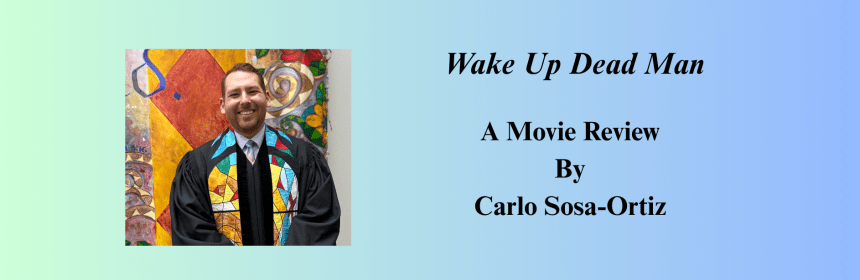
By Carlo Sosa-Ortiz
I, therefore, the prisoner in the Lord, beg you to lead a life worthy of the calling to which you have been called, with all humility and gentleness, with patience, bearing with one another in love, making every effort to maintain the unity of the Spirit in the bond of peace. – Ephesians 4:1-3
Faith and doubt, grace and judgment, humility and certainty all collide in Rian Johnson’s Wake Up Dead Man, the third murder mystery film in Johnson’s Knives Out trilogy. The film brings back Daniel Craig’s loveable southern detective, Benoit Blanc, and introduces Father Jud played by Josh O’Connor. The former a devout skeptic, the other a priest who embodies grace while remaining very human and very flawed.
If you’ve never heard of the movie, here’s a brief description. Benoit Blanc finds himself investigating the seemingly impossible murder of the enigmatic Monsignor Jefferson Wicks (played by Josh Brolin). Blanc is aided in the investigation by Father Jud Duplenticy, a short-fused priest who was brought to the parish as either a form of punishment or hopes that he might replace Wicks as head priest.
From the very first scene, the film invites viewers to explore faith in its messy, complicated, and deeply human forms.
In today’s America, Christianity often seems defined less by what it is for than by what it is against. Political co-option, rigid ideologies, and a focus on defending faith rather than living it out have created a version of the Church more concerned with power than with service.
Brolin’s character acts as this representative. He’s aggressive, overtly masculine, certain, and refuses to go down without some kind of literal or metaphorical fight. His cult of personality garners a small and fearful yet faithful flock who finds his kind of Christianity appealing for a number of reasons: whether because it offers answers, promises healing or power, or because it plays into his congregants’ bigotry.
Had Johnson stopped there, we’d have an overly caricaturized (yet deserved) representation of modern American Christianity. But Johnson, a former Protestant evangelical and self-professed skeptic, shows us that faith can be multifaceted.
Enter Father Jud. The priest serves as the film’s moral compass. He strives to live out Christ’s teachings and guide his flock faithfully. But he’s also not an unrealistic emblem of goodness. In fact, he is deeply flawed, prone to anger, and killed a man before joining the priesthood. But Father Jud is also a man who wants to believe that religion speaks to an unspoken truth, and that desire is what makes faith so appealing.
The film balances this tension between what the Church is and what it could be. More specifically, the film explores the role of faith in believers and nonbelievers alike. Father Jud and Blanc are at opposite ends of the faith spectrum, yet still hold mutual admiration and respect for each other. And that is perhaps the main theme of the film: the power in giving grace to those who least deserve it but who need it the most.
But Wake Up Dead Man is hardly a heavy-handed or sermonic film. Humor and irony constantly cut into the narrative. One scene in particular shows Andrew Scott’s character rail against a “weak” and “effeminate” version of Christianity whose followers submit too easily, oblivious to a painting of a crucified Christ just over his shoulder observing his tirade.
Overall, the film is overtly curious toward religion, reminding us that faith is rarely neat or easy. In a culture that uses Christianity as a tool for dominance or fear, the film invites us to embrace a faith that is humble and relational.
Wake Up Dead Man challenges us to live out Christ’s love, showing that a patient presence is better at bearing witness to the transformative power of grace than strength or coercion. Where the Church has become too concerned with being effective religious or political apologists, we can consider living out our faithful, missional identity instead. An identity that postures itself in humility and seeks to serve the world, not conquer it.
In other words: wake up, look around, and practice mercy. The world needs it, and so do we.
Carlo Sosa-Ortiz is Associate Pastor for Christian Education at First Central Presbyterian Church
 Spirit Of Abilene
Sounds like a really worthwhile movie. I am eager to see it.
LikeLike