
Felicia Hopkins ‘Retiring’ But Will Serve Part Time

By Loretta Fulton
When Felicia Hopkins arrived in Abilene in the summer of 2013, she immediately made history.
She was the first woman senior pastor at historic St. Paul United Methodist Church and its first Black pastor. But soon she was just “Felicia,” with no historical references attached. A committee at St. Paul selected her from a blind resume because of her qualifications and her history, not because she was a Black woman.
“I wasn’t really aware of what a monumental appointment going to St. Paul was at the time,” she said. “I was focused on the challenge, not the history.”
Felicia served at St. Paul for several years before her bishop at the time, Rev. W. Earl Bledsoe, named her superintendent of the Amarillo District. Following a stint in the Panhandle, she returned as Abilene District Superintendent. After a varied career, from the corporate world to Army chaplain during Operation Iraqi Freedom to pulpit minister to district superintendent, Felicia is retiring–but only partly so.

Felicia Hopkins
She will be serving as part-time pastor at the new Open Door UMC that formed in Clyde as part of a transition that the United Methodist Church is undergoing. The church has experienced momentous change in the past few years, with many conservative congregations leaving to become independent or join the new Global Methodist Church. The only remaining United Methodist Churches in Abilene are St. Paul and St. James. The Clyde UMC left the denomination, but a few loyal United Methodists formed the new congregation, Open Door. Felicia will serve as their temporary pastor through June 2025. She will be there at 10 a.m. Sundays two to three times a month.
When Felicia first arrived in Abilene in 2013, she caught everyone’s attention with her energetic preaching style. And that wasn’t just the folks in the pews at St. Paul. The Holy Week Luncheon Series is a popular event held each spring among the sponsoring churches. Originally, those were St. Paul, First Central Presbyterian, First Christian, and First Baptist. First Christian has since moved from downtown, and Highland Church of Christ now holds the fourth spot. Felicia was immediately popular with the Holy Week Luncheon Series crowd and its ministers.
In an Abilene Reporter-News story in 2019, Cliff Stewart, pastor at First Central Presbyterian Church, commented on the spark that Felicia brought to the luncheon series.
“To our group of downtown pastors, she has brought an enthusiasm that cannot be quenched with a firehose,” Stewart said. “And I’m glad.”
As her ministry once again transitions, Felicia leaves us with this gift:
Lessons Learned
Fall in love with Jesus, not the Church
Relationship building is one of the most important things we must continually do. We must reach out and build new ones, repair old ones, and learn to love others and ourselves in a myriad of ways.
Being a disciple means….Doing what you can do, with whatever you have, to the glory of God .
The Holy Spirit is not the third child or leftover from God. The Holy Spirit IS God!! Learn to be in tune with your spirit.
Forgiveness is very very powerful, healing and restorative. Don’t allow the evil one to steal your power.
Everybody matters and everybody counts So be very, very mindful.
Your purpose isn’t out there somewhere; it is IN you. Be you!!!
Fear not–Isaiah 41:10
If God has brought you to it, the Divine will bring you through it.
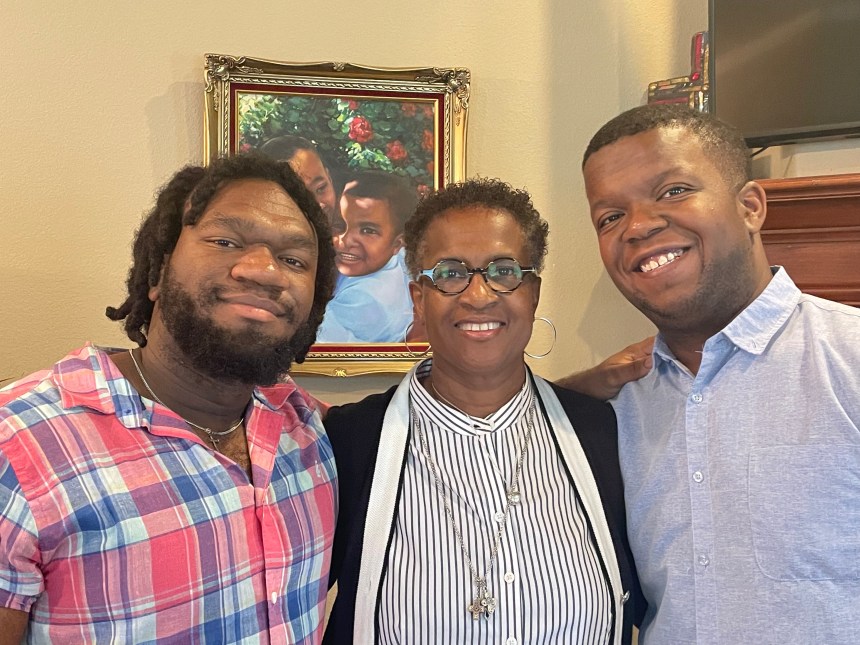
Felicia and her sons, Samuel, left, and Adam
A Q&A With Felicia
Q You have had a varied career in ministry–Army chaplain, pulpit ministry, and administrative posts. What do you want your legacy to be in all those realms?
A I think I want my legacy to be that I helped/loved everyone. That I showed up every day the same as I did on Sunday morning from the pulpit.
Q When you were appointed pastor of St. Paul UMC in 2013, you were the historic church’s first Black pastor and first female senior pastor. Were you apprehensive about the appointment?
A I wasn’t really aware of what a monumental appointment going to St. Paul was at the time. I had just grown a congregation from 17 to over 1,000 in El Paso. I was focused on the challenge, not the history. Yes, I knew I would be the first Black woman pastor. But the St. Paul committee looked at my resume blindly and unanimously said I was the best qualified person. I just happen to be an African American woman. I wanted to say that it was a gamble when I went to St. Paul. The board was a little afraid but they wanted to turn the church around. The lesson learned is trust in God and not in your fears.
Q After you rest for a while, do you have plans for future ministry such as mission trips, getting involved in organizations that you didn’t have time for, etc.?
A I plan to stay active with McMurry and Meals on Wheels.
Q You are a gifted preacher. Do you foresee continuing as a supply preacher or occasional guest speaker?
A I will always preach. At heart, I am a preacher. I took a UMC course called Transitional Intentional Interim Minister. So I mean to be used as an intentional interim pastor for anywhere from 3 to 12 months as needed all over Texas in the UMC.
Q You are retiring at a time that is especially turbulent in the life of the United Methodist Church. How do you think the split will affect the UMC long term?
A I see great things for the UMC. It will be smaller, but stronger and more focused in multiplying disciples. Remember all the people we now called UM voted to stay and be open to whomever decides to come or preach in our local churches. Only 15 percent of the whole church disaffiliated. So 85 percent of the church stayed. In California, for example, they lost maybe 10 churches out of 400. You saw it here because the southwest conferences saw most of the flight. We are much more theologically conservative than the rest of the UMC.
Q With the coming unification of the Northwest Texas Annual Conference and two other conferences, do you see a bright future for the former NWTX congregations?
A The unity of all three conferences (Northwest Texas, North Texas, and Central Texas) will only strengthen who we are. The new conference will be called the Horizon Texas Conference. They have already adopted a new mission statement and five critical areas of ministry.
It will be imperative that smaller rural churches pick a critical area of ministry and go all in 100 percent to build a brand and identity.
The five areas are:
Multiplying Disciples
Embracing Diversity
Caring for Churches, Laity and Clergy
Telling Our Story
Championing Children and Youth
Q What brought you the greatest joy in your ministry?
A My greatest joy in ministry has been helping people, primarily women and young people, transform their minds and hearts for Jesus Christ. It has been planting seeds of healing in the lives of those who have been hurt by the church. Or done with the church. Also, serving my country and helping over 350 Wounded Warriors in the Iraq war. Finally, it has been showing that African American women pastors can lead at a high level of success.
Q Anything else you wish to add
A I have tried to be faithful first to God and then to my calling for almost 30 years. I have not been perfect. But I hope I have been an example of how to “never let go of God’s hand.” Most of the people I have served with or for have been amazingly good, solid folks who just wanted to learn to follow and love Jesus more.
 Spirit Of Abilene
Felicia, Abilene and the Big Country are pleased to have you among us any time for any reason. You are such a bright light!
LikeLike