
Betty Bradley Called to Lead Meals on Wheels Plus
MEALS ON WHEELS PLUS
Click here for a story on the 50th anniversary celebration dinner, with link to purchase tickets
BETTY BRADLEY
Birthplace: Monte Vista, Colorado
Hometown: Grew up on a farm near Swede Corners, six miles from Saguache, Colorado
Family: Daughter in Abilene; son, daughter-in-law, and grandson in Pflugerville; twin granddaughters in Chicago; oldest granddaughter, her husband and first great-grandchild in Irvington, New York
Community involvement: Formerly president of United Methodist Women at Fairmont United Methodist Church and member Church Women United; former Girl Scout leader and member of Girl Scout board; former member of city Board of Building Standards; one of three founding members of Food Bank of West Central Texas; charter member and officer of Meals on Wheels Association of Texas; member St. Paul United Methodist Church and Inquirer’s Sunday School classMILESTONES
1971–Pilot program of Community Action Program
1972–Pilot program ends and meals program is picked up by Church Women United
1973–Betty Bradley signs up to deliver Meals on Wheels
1975–Meals on Wheels Plus becomes a nonprofit with a board of directors1977–Meals on Wheels Plus opens its first kitchen at University Baptist Church
1987–University Church of Christ donates property for new building at 949 Mesquite St.
2002–Meals on Wheels Plus grows to served over 725 meals per day
2004–Meals on Wheels Plus moves into its new 9,573 square-foot location at 717 N. 10th St.
2025–Meals on Wheels Plus celebrates 50 years as a nonprofit
By Loretta Fulton
Meals on Wheels Plus has hit some potholes, roadblocks, and detours in its 50-year history, but never a dead end.
That’s due in large part to the steady hand of its driver, Betty Bradley, who has been the one constant in the agency’s history. Meals on Wheels Plus will be celebrating its 50th anniversary with a dinner on May 22, featuring former Pittsburgh Steelers quarterback Terry Bradshaw as guest speaker. (Click here for a story on the celebration dinner, with link to purchase tickets). Meals on Wheels began in 1971 as a pilot program with the former Community Action Program but became an official nonprofit in 1975.
Betty’s leadership of Meals on Wheels Plus has been an evolution. She was asked to be the unpaid volunteer leader of the new nonprofit in 1975.
“Me!” was her immediate response. “I just have a high school education.”

Betty Bradley
She argued that she didn’t have the necessary skills and wasn’t good at speaking before groups. She did, however, have the very quality needed–a passion for the program. She agreed to think about it, and then in June 1975 Betty was at a meeting of the former United Methodist Women. The devotion for the day was based on John 21: 15-17, in which Jesus asks Peter three times if he loves him. When Peter insists that he does, Jesus replies with some form of “Feed my sheep.” It was the answer to Betty’s prayer.
“For many years I haven’t been able to read this scripture out loud without crying,” she said. “I felt very strongly that it was a calling on my life.”
Betty grew up around elderly relatives and developed a love for older people. Her life began in Monte Vista, Colorado, and she grew up near Saguache, Colorado. In addition to Betty’s parents and three younger siblings, her “ideal grandfather” lived with the family.
“He loved to tease, which I inherited,” Betty said.
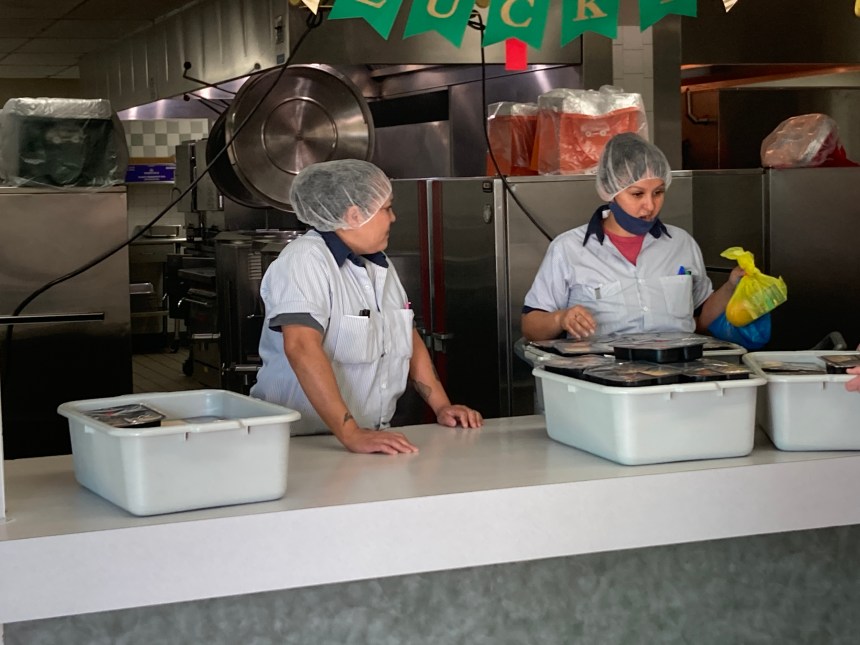
Employees place meals and in bins for volunteer drivers to pick up.
Her grandfather had brothers and a sister who lived close by. Her extended family also included a lot of second cousins. Betty graduated eighth in her high school class (don’t ask her how many were in the class). Some people from Abilene hunted on property owned by a neighbor and talked about the job opportunities in Abilene. Lured by that prospect, Betty came to Abilene several months after graduating high school. She raised a daughter and a son here. Her daughter stills lives in Abilene and her son and his family live in Pflugerville.
Betty joined the former Fairmont United Methodist Church and served as president of the former United Methodist Women there for three years. She also was a member of Church Women United, which sponsored Meals on Wheels. The program was started in 1971 as a pilot of the former Community Action Program (CAP). The pilot program ended in 1972 and was picked up by Church Women United.
“They started with the eight most needy people who had been served by CAP,” Betty said. “They relied on donations from churches and used volunteers to deliver meals.”

Meals on Wheels Plus volunteers pack coolers of food for delivery.
The pilot program had purchased meals from a cooking school located in the old Woodson High School. When Church Women United took over, meals were purchased from the former Barton’s Cafeteria in River Oaks Shopping Center. Eventually, the women began purchasing a small number of diabetic meals from Hendrick Medical Center. When the Congregate Meal Program began in Abilene, some meals were obtained from the Rose Park Senior Center.
Church Women United continued their sponsorship until 1975 when it was determined that Meals on Wheels should be a community-based program.
A group of 29 people was selected from the community to develop a structure for the program.
A committee from that group began looking into the fairly new federal Social Services Block Grant. The committee soon discovered that the funds could only be used to purchase pre-packaged meals, not food for meals from scratch.
“So, the group of 29 people disbanded and turned the program over to the board of directors they had selected,” Betty said.
Betty was elected treasurer and soon was asked to be the volunteer program director. Prior to that, her full time job was being a stay-at-home mother to her son and daughter.
Today, Meals on Wheels Plus has grown to 110 routes in Abilene and 14 rural communities. The “Plus” includes delivery of pet food, transportation of pets to a veterinarian for annual exams, a grocery bag of staples once a month to food-insecure recipients, and delivery of books from the library.
A source of pride for Betty is that during the last fiscal year, 90 cents of every dollar went to feed needy people. Of the remaining 10 cents, 8 was spent on administration and 2 on fundraising. Another point of pride has been that the agency has never incurred any debt. When the first building was constructed at 949 Mesquite St., it was completely paid for before moving in. When the program outgrew that facility, a new kitchen and offices were built across the alley. That, too, was paid for before moving in.
Betty turned out to be the best choice to lead Meals on Wheels Plus, despite her early doubts. She became a charter member and an officer in the Meals on Wheels Association of Texas when it was formed. She and others were able to get a bill passed in the Texas Legislature that created a new funding stream for Meals on Wheels programs in the state. The bill was signed into law in 2007 by Gov. Rick Perry, whose sister, Milla Perry, was one of the first members of the local board of directors and its first dietician. In 2023, the association was able to work with state legislators to increase the common provider meal rate from $5.31 to $6.46 per meal.

Currently, Meals on Wheels programs nationwide are facing a possible cut in funding from the federal government. The local program receives $1.9 million annually from a federal Social Services Block Grant (SSBG). The remainder of its $3.7 million annual budget comes primarily from fundraisers and donations. Some clients make donations for their meals and some funds come from foundations.
“There have been very hard times in the past,” Betty said, “but none like this current threat.”
Funding for Meals on Wheels Plus has been aided over the years by the creation of an endowment fund that people can donate to in honor of or in memory of someone. The endowment began as a savings account when faithful volunteers June and Marshall Clark were involved in a bad accident and June later died from her injuries. A church in Dallas made a $5,000 donation in her memory and the savings account was created. The endowment now has enough money to get the agency through a few years if the SSBG grant is lost.
With the possible loss of the grant looming, Betty and her board and staff are looking at ways to trim the budget even more, including tightening eligibility guidelines and seeking more financial help from clients.
“When times are tough,” Betty said, “We cut back, work hard, and ride it out.”
Loretta Fulton is creator and editor of Spirit of Abilene
 Spirit Of Abilene
Betty Bradley defies definition! She is amazing!
LikeLike
Betty Bradley is truly a living saint!
LikeLike