
A Stoplight View, Courtesy of Bessie Radford

By Jay Moore
Should you get caught waiting on the light at S. 14th and Sayles, you have four viewing options: a vape shop on the southeast corner, a pawn shop to the northeast, a convenience store habitually offering non-competitive gas prices on the northwest corner, or you can look to the southwest and see a manicured grassy expanse punctuated with an iconic Gothic edifice on the campus of McMurry University. I’d suggest you spend your stoppage time not looking at your phone or the vape/pawn/gas-gouging corners, but instead opting to gaze at the best view possible, the southwest corner.
Dominating that busy corner is McMurry’s Radford Auditorium. (I suspect out-of-towners passing by think they are looking at a church. They are not.) The actual name of the building is the J. M. Radford Memorial Student Life Center, but Radford Auditorium is more succinct and has become the common moniker; plus Student Life is now in the Campus Center. The building was given by Bessie Radford in memory of her husband, James Radford, an Abilene business titan and a man deserving of his own Hometown History write-up. (Give me time. Also, the school’s original auditorium, located on the southside of Old Main, was known as Radford Auditorium following a 1939 gift by Mrs. Radford that added 33 feet to the that auditorium. Today it is named Matthews Auditorium. You get one guess as to why.) The new Radford Auditorium was completed in 1950; however, the story begins three years earlier.
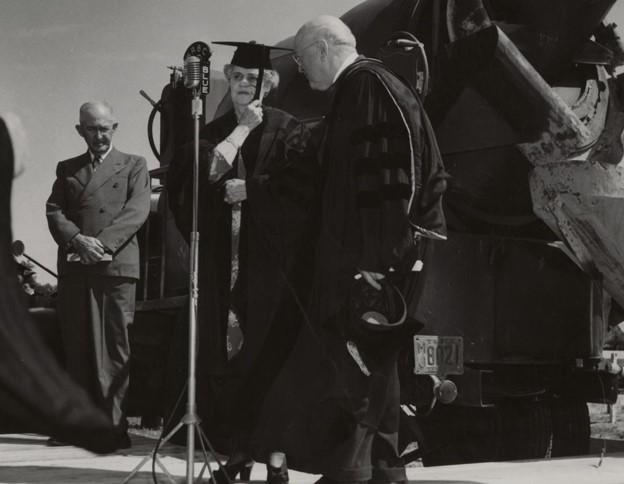
Bessie Radford and Dr. Harold Cooke at the groundbreaking ceremony. Mr. S.M. Jay is to the left.
In March of 1947, McMurry College president Dr. Harold Cooke received the biggest surprise of his tenure, and it came during one of the most trying times in his life. A month earlier Dr. Cooke had been driving along Highway 36 south of town when he lost control of his car. He managed to crawl back to the roadway and wave his handkerchief to signal a passing driver. Suffering from a broken neck, and a number of less serious injuries, Cooke was quickly delivered to Hendrick Hospital.
Still hospitalized a month later, Dr. Cooke was preparing to take part in a noontime meeting of McMurry trustees via the 1947 equivalent of a Zoom call — a radio-telephone hook-up. Right before the meeting began, a visitor knocked on the door of Cooke’s hospital room; the man entered bearing unbelievably good news — news which would give Abilene one of her most iconic buildings.
Into the room stepped Mr. Hatley Harrison. Harrison was a member of the McMurry board of trustees and was also the manager for Radford Properties, the largest commercial landlord in Abilene at the time. Harrison’s backstory is that he began working for Radford Wholesale Grocery in 1903 and, by 1942, had risen to become the general manager of the 33 wholesale grocery warehouses operated by Radford in Texas, New Mexico, and Oklahoma. By 1947 he was also a trustee of Mr. Radford’s estate and managed Radford Properties on behalf of Bessie, the widow of his former boss. (Radford had died suddenly of a heart attack on July 4, 1933.)
The bed-bound McM president welcomed Harrison into his room but advised that he was about to be part of a trustee meeting over the phone line, to which Harrison replied, “Good. Then you can relay this news to them.” With a smile a mile wide (I presume), Harrison informed Dr. Cooke that his employer, Bessie Radford, had decided to make a gift to the school. And not a small one; it would be the largest gift in the school’s history up to that point. Cooke was overwhelmed. And, a few minutes later, over the telephone hookup, he passed along the astonishing news to the assembled school trustees who were stunned into silence. The entire cost of a student life building, including the furnishings, was to be covered by the generous benefactress. It was a gift clear out of the blue.
Given post-war inflation, her initial 1947 gift of $300,000 proved insufficient to cover construction costs, so she tossed in an additional $300,000 in 1949. In all, her $600,000 gift is the equivalent of $8.8 million in today’s dollars. Mrs. Radford, a Presbyterian, made her donation to the Methodist college so it could construct a Gothic style building housing an auditorium and a student life center which, in the words of Dr. Cooke, would “forever stand as a symbol of the purpose and spirit of McMurry.”
The building, positioned to face the intersection of Sayles Boulevard and South 14th Street, was designed by Abilene architect David Castle and features a 100-foot tall tower. The building has two fronts and no rear. (If you’re skeptical, go walk around it.) Ground was broken in 1949 as the white-haired Mrs. Radford, standing next to Dr. Cooke, released a lever, sending a load of concrete into the building’s massive foundation.
A dedication ceremony of the J.M. Radford Memorial Student Life Center was celebrated over two days in October of 1950 with Methodist bishops, local dignitaries and some two thousand others arriving to see the finished building and pay homage to the generous Abilene lady who had first arrived here in 1886, and who spent a lifetime helping to build and improve the city she loved.
Less than a year after the dedication, Bessie Radford died on August 25, 1951. A large contingent of grateful Abilenians gathered at four o’clock to attend her funeral, held on the campus of McMurry in the Gothic centerpiece which she made possible.
So, next time you’re tapping the steering wheel at S. 14th and Sayles, look southwest and take it all in anew.
Jay Moore is a retired Abilene High School history teacher and creator of the History in Plain Sight DVD series
 Spirit Of Abilene
I always enjoy reading your interesting back stories about Abilene’s sites. I didn’t know the history of Radford.
LikeLike