
The Sleeping Sentinel
By Danny Minton
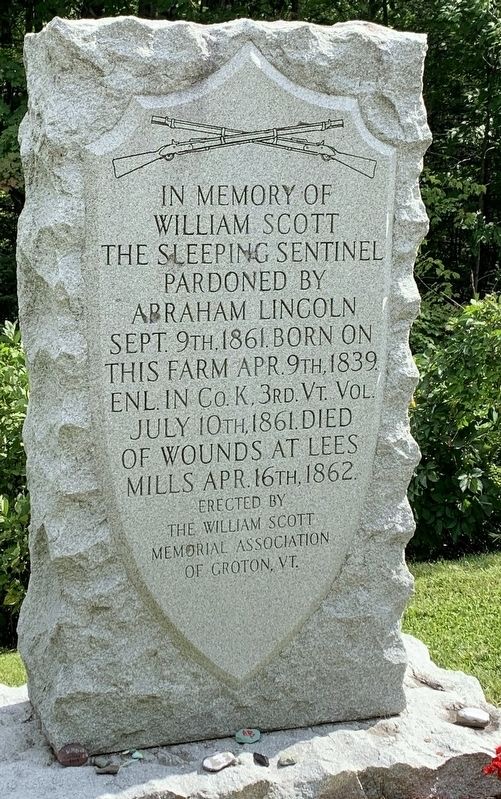
Midway within the state of Vermont lie the towns of Barre and Groton. As you leave Barre traveling east on Highway 302, you’ll discover you are on the William Scott Memorial Highway. As you travel down the highway, you will eventually come to a marker located at 44º 12.279’ N, 72º 15.957’ W, near Groton. The question for most of us would be, “Who was William Scott, and why did he receive such an honor, an honor that would not have been possible without a request from Abraham Lincoln?”
William was 22 when he joined Company K of the 3rd Vermont Volunteers in July 1861. The first few months of training were exhausting, with endless hours of training. William’s regiment was assigned to guard Chain Bridge, and William volunteered to guard the bridge for a fellow soldier who was ill. This was an important task, as evident by a Union loss at Manasses Junction, possibly aided by a sentry who had fallen asleep. Those in command decided to assess the penalty for a sentry sleeping on duty to be death.
William had already done one shift and was exhausted, falling asleep at his post. When discovered, he was immediately arrested and sentenced to death. The penalty was severe and William was undeserving of such a strict punishment to his comrades. A petition was signed by almost 200 soldiers requesting a pardon for William. Scheduled to be shot on Monday morning, by chance, the pardon request had made its way to President Lincoln, possibly by a chaplain. On Monday, September 9, 1861, the day of the execution, Lincoln sent word to the commanding officers giving William a presidential pardon. One version of the story says Lincoln himself took the message to make sure it was received. It is said that William promised President Lincoln that he would never fall asleep again while on duty.
In April of 1862, William Scott was sent with over 190 of his fellow soldiers against the Confederate forces at the Warwick River in Lee Mills, Virginia. William was mortally wounded while carrying a wounded soldier across the river. He reportedly saved several others through the journey across the muddy river. William lay dying and asked, if possible, that President Lincoln be notified and thanked for letting him die like a soldier and not by a firing squad.
Of all the people I have met over the decades of my life, I have never met anyone who has never made a wrong decision, made a mistake, or done something they regret. Sometimes, the miscues of life are minor; other times, they can have significant consequences for us or those around us. However, they do happen whether we mean for them to or not. We all make mistakes and bad decisions.
Unfortunately, we live in a world with little tolerance for people who make mistakes, wrong decisions, or plans that do not work out. While people want to be forgiven and given second chances for personal failings, they are reluctant to let someone else’s faults pass without harsh criticism. Why is it that we expect perfection from others and tolerance for ourselves?
John relates the story of a woman who had been caught in the act of adultery, brought to Jesus, thrown at his feet, and asked, intending to trap Him, what should be done to her. Jesus answers them, “Let the person without sin throw the first stone.” He then knelt and began to write in the dirt. When he arises, he sees only the woman, and everyone else has left. He asks her, “Woman, where are they? Did no one condemn you?” She responded that no one was left to condemn her. Jesus then said, “I do not condemn you either. Go. From now on, sin no more.” Some of the final words of Jesus spoken in pain from the cross were simply, “Father, forgive them; they don’t know what they are doing.”
The men who brought the woman were made to look within themselves and realize they, too, possessed faults. From the cross, Jesus understood that people make mistakes and bad decisions, especially those who don’t have all the facts. Like them, before we “crucify” someone for their mistakes or bury them because of wrong decisions, we should take the time and effort to look within our hearts and lives, recognizing that we, too, have, at times, “messed up.” We should never define a person by one or two wrong turns in their life. As Jesus said, “Treat others how you want to be treated.”
On the other hand, when we are given pardon for something we did wrong, we should stand up to it and strive to do better. We often learn more from what we do wrong than when things always go easily. “Go and sin no more,” were the words of Jesus to the woman. In other words, “I’m giving you a second chance; take time to make the right decisions.” It takes a strong individual to admit their wrongs and an even stronger person to decide to change.
The commanding officers decided to go forward with the execution of William Scott. The troops were assembled, Scott was blindfolded, and the firing squad assembled. The commanding officer then pulled out a paper and read the pardon from President Lincoln. William Scott was freed. The ultimate forgiveness for all our mistakes and bad decisions will come one day when we stand before our God and the Son proclaims to the Father that our sins have been pardoned by Him by way of the cross.
Danny Minton is a former Elder and minister at Southern Hills Church of Christ
 Spirit Of Abilene