
Meet Alisha Taylor

Click here to read article about ICAN’s Heroes’ Luncheon, including ticket information.
By Loretta Fulton
Alisha Janette Taylor is making quite a name for herself in her hometown as an actress, producer and director of documentary films.
And now she can add “Hero” to her resume. On Thursday, April 9, she will be honored at the annual Heroes’ Luncheon, sponsored by ICAN (Interested Citizens of Abilene North), whose motto is “I Can. You Can. We Can.”
An email said the following about Alisha’s selection:
“(Alisha) has worked diligently to capture the spirit of our communities through her creative lens and constantly evolving her craft artistically.”
Alisha is well known at Abilene Christian University, where her father, Dr. Jerry Taylor, is a religion professor and founder of the Carl Spain Center on Race Studies & Spiritual Action. Alisha performed on stage as a student at ACU, where she earned a bachelor’s degree in musical theater in 2017.
In 2022, she created the documentary, “A Legacy Unearthed: The History of Black Abilenians” and is pleased that she is being honored at the Heroes Luncheon for that film and others.
“I am proud to have created a voice for myself with the art that I make and represent the community that shaped me,” she said.
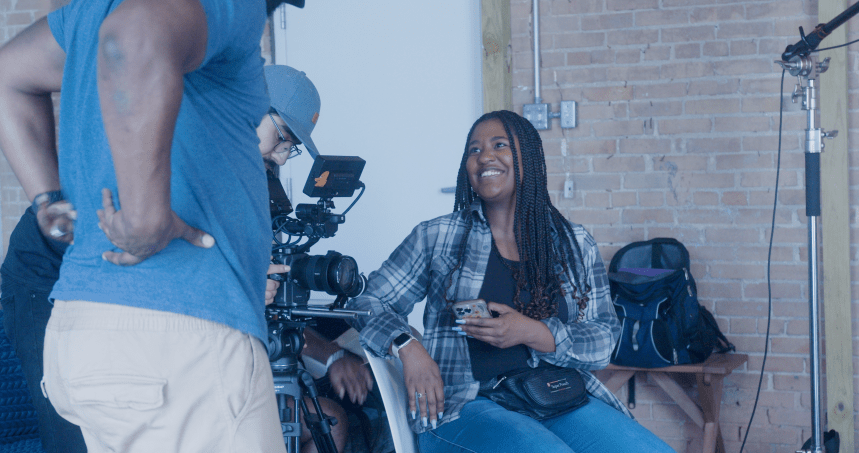
Alisha Taylor on set
Bio:
Hometown: Abilene
Education: Alisha is a product of Abilene schools, including Taylor Elementary School, Franklin Middle School the last year it was open and Craig Middle School the first year it opened. She is a 2013 graduate of Abilene High School and a 2017 graduate of Abilene Christian University, with a bachelor’s degree in musical theater.
Occupation: Actress, producer, and director. Alisha started with performing onstage. With a BFA in musical theatre, Alisha has performed in shows such as “Nickel and Dimed,” “Mary Poppins,” “Big Fish” and “The Mountaintop.” She has performed “The Mountaintop” multiple times, once at Valpraiso University in the Chicago area and another at Theatre 71 in New York.
Background: With an innate love of creativity, Alisha began to work with film. She completed a short film,”Baggage,” at the Nate Parker Film Institute at Wiley University, which had a private screening at the 2018 Pan African Film Festival. She was a part of the production team on the short film “Nazen” which also was selected for the 2021 Pan African Film Festival, and was nominated for Best Short Film.
Since then she has ventured into documentary filmmaking and started her own production company, Taylor Made Studios. Alisha has produced a number of documentaries. She produced and directed a short subject documentary named “The Mississippi Delta Experience” and served as the Archival Producer for the docuseries, “I’ve Been Waiting.” In 2022 she completed her feature length directorial debut with “A Legacy Unearthed,” a documentary based on the Black history in her hometown. This film was an official selection of the 2023 Queens Underground International Black History Film Festival.
Most recently, she was given the opportunity to direct an original showcase called “Tapestry” which aims to highlight the talents of the students of color in the ACU Theatre Department. Through the showcase, she carefully curated a series of pieces that showcased the unique and diverse perspectives of the students, and provided them with a platform to express themselves and their creativity. Most recently, she was given the opportunity to guest direct John Proctor is the Villain at the Historic Paramount Theatre in the Fall of 2024. Her current work, “Da’Cipher 360,” is a documentary that focuses on mass incarceration within the state of Texas. Alisha held a local community screening in August 2025, and through partnership with The Sentencing Project, the film also screened in Detroit in September 2025. The film is currently on the festival circuit in 2026. She also teaches Hip-Hop at Key City Dance, and has led multiple African Dance workshops at the collegiate level.
Q Have you made any documentaries since “A Legacy Unearthed: The History of Black Abilenians”?
A My most recent documentary is “Da’Cipher 360.” The film looks at the life of Robert Lilly. This film takes an intimate look at Robert’s personal journey and the lives of the people he impacted. Highlighting his journey in and out of the prison system, and his passion for youth, shows us how powerful, flawed, and beautiful human life is. Da’Cipher 360 was a youth peer support ministry. It was a nonprofit organization that was designed to both prevent incarceration of youth and reinvent the once incarcerated. When Robert created Da’Cipher 360, it became a meeting place for youth who were challenged in their lives by drugs, gangs, feelings of abandonment, and general despair. He made it his mission to stand in the gap for the youth and help them decipher the purpose of their lives. The film highlights the spiritual, mental, and emotional turmoil Black leaders experience while bringing to the forefront this country’s over reliance on prisons and mass incarceration. Since the completion of principal photography, Rob has gone on to get married and now serves as the Vice Chair of the Travis County Reentry Roundtable in Austin, Texas. I hope that people will want Rob to come out and speak to their organizations and communities. At the time, Da’ Capher 360 was a thing of the past, but since the completion of the film, Rob and a few other men who were incarcerated with him are seeking to revive the nonprofit.
Q Where did you learn your documentary skills?
A I began studying and working with film at The Nate Parker Film Institute. The main focus was on narrative writing, but we did have one class on documentary filmmaking. After I completed the program, we were invited back as alumni to mentor the incoming class. The alumni were also given the job to film a behind the scenes documentary about the current class. Being able to do this really gave us hands-on experience. Stories are the lens through which I view the world. The first artists I encountered were my family members—great uncles sharing tales about family that had passed or cousins having competitions to create the most imaginative bedtime stories. My family, like many other Black families from the South, has strong traditions of oral history, which have significantly influenced my appreciation for storytelling.
Q You have spent much of your life in Abilene. When did you first become interested in the history of Black Abilenians?
A I’ve always been interested in history. Before I decided to pursue theatre and film, I actually wanted to major in Anthropology. Working on documentaries really is a beautiful intersection of those things. I don’t believe there is a pinpoint moment where I suddenly became ‘interested’ in the history of Black Abilenians. Rather ‘preserving’ the history of Black Abilenians. Since most of the Black community has had to preserve histories through an oral tradition I learned things from those around me. I remember being little and Sis. Dorothy Wiseman would give me a big kiss on my cheek every Sunday and it would leave a lipstick mark. She was the secretary at Woodson High School and was also a teacher. Sis. Wiseman was a part of desegregation in Abilene.
Q Your brother Jeremiah was an intern at Curtis House Cultural Center. Did he have any influence over you interest in making “A legacy Unearthed”?
A My brother is one of the main reasons I had the idea to make “A Legacy Unearthed.” While he was an intern he would often voice concerns about the lack of financial support the cultural center was receiving, or lack thereof. I originally wanted the film to be a short subject doc, around maybe 15 to 20 minutes. Very quickly it became clear that the film needed to be longer to really do justice to the history and legacy housed there.
Q You grew up in a religious household. How did your parents relate the connection between faith and struggle for civil rights?
A Faith has always helped to sustain people during oppression. One of your strongest tools as a filmmaker is humanity, and I think that ties directly back to faith. The biblical themes of liberation and justice require you to see the humanity in someone else.
Q Why is being honored at the Heroes Luncheon important to you?
A I am proud to have created a voice for myself with the art that I make and represent the community that shaped me. I often feel like I am racing against time to preserve history through film because there is just so much. So it means so much to me to receive this award as a reminder and encouragement that this work is important.
Loretta Fulton is creator and editor of Spirit of Abilene
 Spirit Of Abilene