
Finding God in Minneapolis
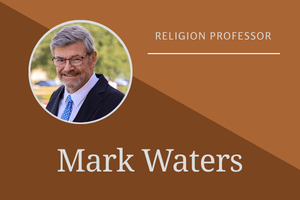
By Mark Waters
“The only thing necessary for the triumph of evil is for good people to do nothing.”
This statement of wisdom, worded in different ways over the years, has been attributed and misattributed to a number of historic figures. The earliest verifiable source that I can find is the Rev. Charles F. Aked (1864-1941), an English clergyperson who moved to the U.S. in 1906 to serve the Fifth Avenue Baptist Church in New York City.
Regardless of the human source, the power of this message is actualized when good people do something courageous and, potentially, transformative. A case in point is the courageous people of Minneapolis who are nonviolently resisting sinful forces that separate families, terrorize children, brutalize innocent people, commit public and probably secret executions, disregard due process, ignore constitutional guardrails related to habeas corpus, and otherwise terrorize human beings who are created in the image of God.
The courageous resistance includes six hundred plus clergypersons and other leaders of a variety of denominations and faith traditions who traveled to Minneapolis to stand in solidarity with residents attempting to support their neighbors. Their presence is a symbolic representation of the Love that Grounds all reality, of loving neighbors, and even loving enemies while nonviolently resisting those who make themselves enemies through perpetuating terror.
Clergy presence bears witness to the eternal truth that the God who cares for the broken-hearted is always, already present. If the cross means anything, it means that God is present in suffering. This divine identification with others includes all people who suffer regardless of the color of their skin, their immigrant status, their social status, their age, their innocence or guilt, or any “Otherness” that we human beings tend to judge rather than love.
In human terms, when I make someone else suffer, I’m contributing to the suffering of God. Stated Christologically, harming someone else means that in some sense I’m participating in the crucifixion of Christ. For better or worse, “just as you did it (or did not do it) to one of the least of these brothers and sisters of mine, you did it to me (Jesus)” (Matthew 25: 40, 45, NRSVUE).
The clergy and faith leaders who converged in Minneapolis represent Christian, Muslim, Jewish, Buddhist, and Indigenous spiritual traditions and more. At the core of each tradition is a commitment to service and to the dignity of every human being. The Episcopal Baptismal Convenant that we recite at every baptismal service says, in part, “Will you seek and serve Christ in all persons, loving your neighbor as yourself? … I will with God’s help. … Will you strive for justice and peace among all people and respect the dignity of every human being? … I will with God’s help.” The eighth of Thich Nhat Hanh’s Fourteen Precepts of Engaged Buddhism is, “Make every effort to reconcile and resolve all conflicts, however small.” The Hebrew Bible calls upon God’s people to “…do justice, love kindness, and walk humbly with God” (Micah 6:8). The Quran of the Islamic faith states “O mankind! We created you from a single (pair) of a male and female, and made you into nations and tribes, that ye may know each other (not that ye may despise each other)” (Surah 49:13). Indigenous traditions are profoundly diverse. Nez Perce Chief Joseph proclaimed relevant words for the context of this article, “Treat all people alike. Give them the same law. Give them all an even chance to live and grow. All people were made by the same Great Spirit Chief. They are all brothers [and sisters]. The Earth is the mother of all people, and all people should have equal rights upon it” (1879 speech in Lincoln Hall).
While clergy and faith leaders of these spiritual traditions and others carry great symbolic meaning, in concrete terms they are no different than any of us who are also responsible—in our own way, according to our calling from God, in whatever way we can—to stand up for people being cruelly marginalized and sometimes unjustly detained, brutalized, or murdered in our country. In our own way, we need to stay ahead of the Rev. Martin Niemoeller’s haunting words, “and then they came for me, and by then there was nobody left to speak up.” God is calling us to seek and find nonviolent ways to resist the evil that seems closer to home each day.
“The only thing necessary for the triumph of evil is for good people to do nothing.”
We have to look into our hearts, listen to God, and discern our own way to resist, to do something. For some folks, resistance may require an open-eyed willingness to see reality as it is rather than protecting one’s ideology under the shadow of propaganda. In his book 1984, George Orwell wrote, “The Party told you to reject the evidence of your eyes and ears. It was their final, most essential command.”
For others, resistance may simply mean a choice not to let political ideology, xenophobia, or group pressure seduce us into minimizing or rationalizing away the evil that dehumanizes the Other, labels people based on immigrant status rather than their status as children of God, or justifies violence against anyone. Be aware that metanoia, the Greek word often translated” “repentance,” refers to a change of mind or a change of heart. “Everything depends on inner change,” wrote Jewish philosopher Martin Buber, “when this has taken place, then and only then does the world change.”
(My opinions are my own and do not necessarily reflect those of my employer.)
Mark Waters is professor of religion at McMurry University and chair of the Division of Humanities, Religion, and Social Sciences
 Spirit Of Abilene
What a powerful article! I did not know about the delegation of ministers who went to Minneapolis, so I thank you for sharing that. I am so troubled about the current state of the world’s political climate. I watch a lot of European programing and find that it shares much of the American mindset against the “other.” I am ashamed to admit that I am afraid to be very vocal about my “liberal” views.
LikeLike
Bold and prophetic words, Dr Waters. May all good people find the steel in the words, in their spines, to start doing something in this moment. Big things like joining the front line of protest, small things like speaking up and sharing your convictions with others, everything matters. Nothing is wasted.
LikeLike