
Meet Reed Ambrose
By Loretta Fulton
Growing up, Reed Ambrose played typical board games with his family, and that experience obviously had an impact.
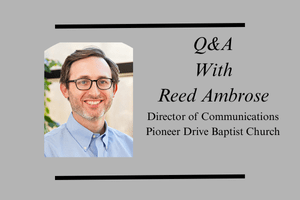
Today, Reed, who is director of communications at Pioneer Drive Baptist Church, develops his own games and apparently is extremely good at it. He recently was cited by a popular entertainment reviewer for creating the best board game played at the world’s largest board game convention in Essen, Germany.
“I felt very honored to even be considered,” Reed said, “especially given the amount of games released at Essen, nearly 1,300 (in 2025).”
Reed is talented and creative in other ways, too. Last April, He played the role of Jesus in the church’s production of The Cross, The Crown, which is presented just before Easter every other year at the Abilene Convention Center.
It’s amazing that Reed finds time to design board games. He and his wife have two young boys, Graham and Holden. The boys are in bed most nights around 8:30, which is the perfect time for Reed to hook up with two game design friends in Reno, Nevada. He credits his wife, Betsy, with giving him time and space for his creative outlet. Reed is off work on Fridays, and uses that time for design work.
“Friday mornings (and sometimes into the afternoon) are nonnegotiable, dedicated game design time,” he said. “I’m usually at the Front Porch downtown, my house or office, depending on the Friday.”
Weekdays are spent at work and squeezing in time to watch videos, read blogs, and listen to podcasts. All that creative input sometimes leads to a new game. Reed knows he is on the right path with game designs. In the past, he tried writing books and had to force himself to get started.
“But then I found my desire to create board games is the opposite, forcing myself to stop doing it at times.”

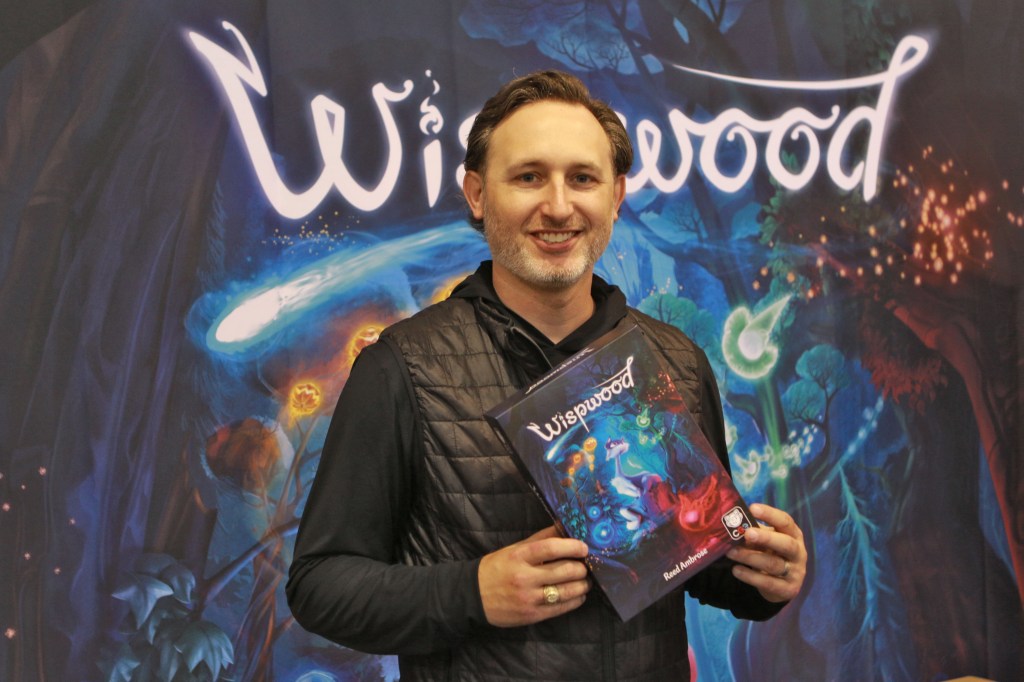
Reed Ambrose with his “Wispwood” that was honored as “best board game” at the world’s largest board game convention in Essen, Germany.
BIO
Current position: Director of Communications, Pioneer Drive Baptist Church
Family: Wife, Betsy; two boys, Graham and Holden
Education: Irving High School, 2006; Hastings College, Bachelors of Arts, 2010; Hardin-Simmons University, Master of Arts in English, 2018
Community involvement: Helping with the Abilene Board Game Group, coaching sports for my boys, and teaching Sunday School class for 4-year-olds with my wife
Q What type of games did you grow up playing?
A I grew up playing all the childhood classics like Risk, Monopoly, Sorry, etc. Thanks to my parents we had a good size game closet.
Q At what age did you design your first game?
A While I’ve pursued creative endeavors my whole life, I designed my first game in January of 2017. I’ve designed a lot of games since but not many make it out of the initial stages of my notebook and first few playtests.
Q Has Wispwood been published? If so, who published it and is it available for purchase?
A Yes, Wispwood has been published with Czech Games Edition, also known as CGE, the makers of Codenames. It is available for purchase in Europe currently and will be available in the States in early February.
Q What game type or genre is Wispwood?
A Wispwood is a tile-laying game for those familiar with that term. The other way to describe it is that it’s like Tetris where you fill in a grid with shapes.
Q You were honored at a convention in Germany. Describe that recognition.
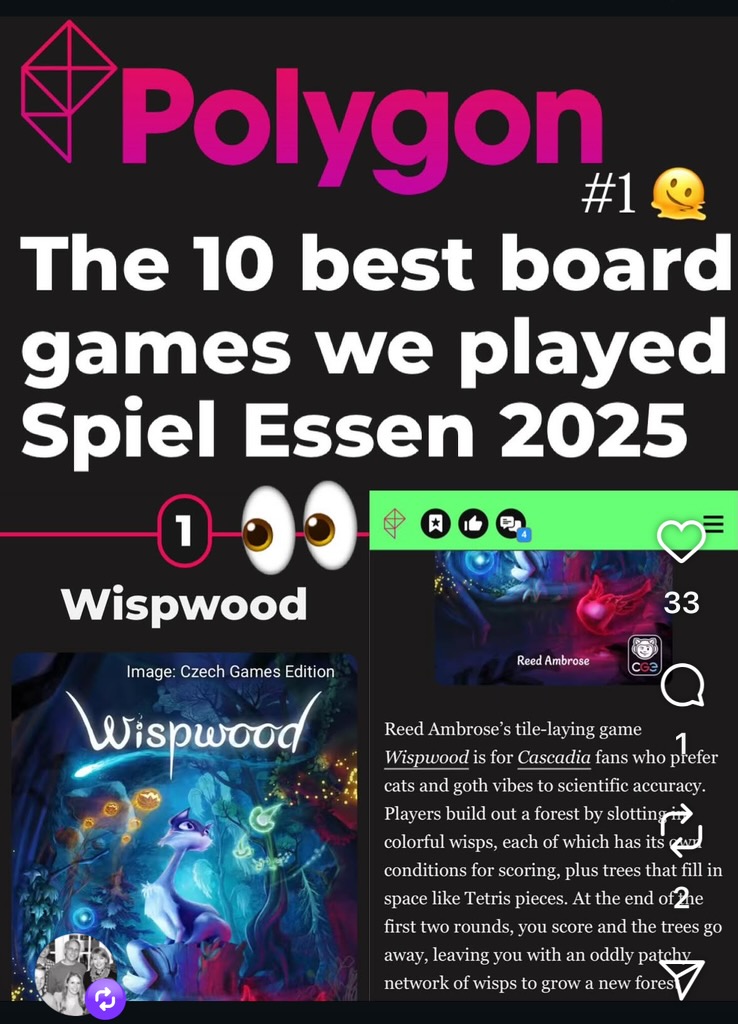
A The popular entertainment reviewer, Polygon, wrote on an article on the best games they played at Essen Spiel, the world’s largest board game convention held annually in Germany, and my game was their #1 on that list. I felt very honored to even be considered, especially given the amount of games released at Essen, nearly 1,300 this year. (2025)
Q How do you turn your game design into an actual board game? (Do you have the equipment to do that yourself or do you send it to a company that does that type work?)
A As a designer, I build prototypes of my games in one of two ways. The first way is digitally through a program called Tabletop Simulator where I can upload digital files I create and test my games there. The other way is to make a physical prototype which involves arts and crafts, cutting out cards, stickering tiles, or gluing pieces, etc. Also, there are some online sites like TheGameCrafter.com who can help print cards and pieces for your game or prototype as well. As a side note, I did not print my game in its final form. That’s the job of the publishing company; like a book getting published, an author doesn’t make the actual final product. I certainly make prototypes beforehand to test my game and improve upon it, but those prototypes are nothing compared to a final product.
Q Did you learn your design skills on your own or in school/college?
A I’ve always had an innate desire to create things. Once I realized you could make a board game and started to learn about the process and the industry, I fell in love with the various aspects to create one. So, it wasn’t until I learned about game design starting in late 2016.
Q What is the gold standard for game design? That may be a particular publisher or a certain prize.
A The top award for a board game is the spiel de jahres, which is the game of the year award in Germany. There are 3 nominations handed out in May for the games published in the previous year, although the game must have been published in German to be considered. From there, a winner is chosen by the committee of the award in the summer.
Q Where do your ideas for games come from? (Life experiences, TV shows, movies, books, other games?)
A Game ideas come from all over for me: literary elements, a favorite story, a silly thought, or a twist on a familiar board game mechanic, etc. Board game design usually starts with one of three avenues: theme, mechanic, or experience. Sometimes you know more than one of those which can be helpful, but often you start with one and then follow the fun of your game as it evolves through playtests and feedback.
Q Do you ultimately want to have your own game design business?
A I do not. I like just being the game designer and being in the thick of the creativity. I have very little desire to be the marketing department, the finance department, the customer service, etc. that it would take to run your own publishing company.

Loretta Fulton is creator and editor of Spirit of Abilene
 Spirit Of Abilene
Nice introduction to Reed and his job. I also like the new look on some of the articles.
LikeLike