
The Next Pope
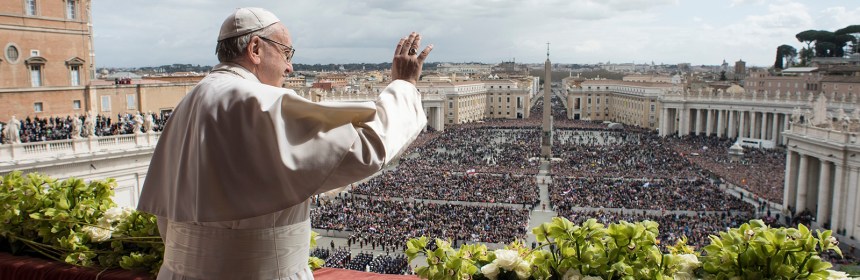
Editor’s note: Funeral for Pope Francis has been set for Saturday in St. Peter’s Square with viewing to begin Wednesday.
By Dr. Paul Fabrizio
The death of Pope Francis on Easter Monday is an opportunity for the Catholic Church to change. The change would not involve dogma, doctrine, liturgy, or prayers. Rather, a new pope will change what the Church speaks about. He will change what the Church focuses on.
Pope Francis, as an Argentinian, came to Rome with a different set of priorities than previous popes. Pope St. John Paul II focused much of his papacy on defeating communism and questioning a consumer society while reminding Catholics of traditional moral teachings. Pope Benedict XVI tried to combat secularism in society through a return of fundamental Catholic truths.
Francis made his first trip as pope to the island of Lampedusa in Italy, known as a place where African and Middle Eastern migrants first landed as they escaped turmoil in their homelands. This attention on refugees shaped his message of outreach to the margins of the earth. Papal trips to Palestine, Albania, Sri Lanka, Sweden, Iraq, South Sudan, and Timor-Leste and many other countries would follow. His message with these visits was for us all to remember the forgotten.
He spoke often of mercy and asked Catholics to listen to the workings of the Holy Spirit. He led two Synods, or Church meetings, on Synodality in 2023 and 2024 where he encouraged Catholics to listen to each other and dialogue with each other. These synods included lay participation and began at dioceses all over the world, including the Diocese of San Angelo. The Pope sat in some of those sessions, sitting at a table with bishops, religious sisters and lay people from around the world. Looking at a picture from one of those meetings, Francis looks just like any other participant.
That is the secret of papal communication. The official words and documents and statements are important but the gestures, the smiles, the hugs, are even more important. What better way to communicate our human equality and Jesus’ love than to hug and kiss a man with neurofibromatosis or go to Mongolia, home to only 1500 Catholics.
The person elected within the next month as the next pope will have the opportunity to create his own path and communicate in his own way the message of Jesus Christ. The pope’s election process, the conclave, will be subject to much political, historical, and theological analysis. Predictions will be made, bets will be placed, all guided by the traditional caution that the cardinal who enters the conclave as the pope, leaves as a cardinal. In other words, the Holy Spirit will be at work.
Here is what we know. The conclave will start within the next three weeks. Participating will be the papal electors, cardinals from around the world. The Vatican website lists 135 Cardinals as electors meaning under the age of 80. All are ordained clergy in the Catholic Church, starting as priests and then being chosen by recent popes for promotion to bishop and then to Cardinal.
Italy, the country of most popes, has only 17 of the 135 cardinals. Europe, the source of almost all popes except the last one, has only 39 percent of the cardinals. Ten cardinals are American, 18 from Africa, 23 from Asia. It is truly an international cast.
Pope Francis dominated news coverage of the church just like previous popes before him. Consequently, the possible next pope choices are little known to the public, but this is the case in almost every papal election. Probably the best known is the Papal Secretary of State Pietro Parolin, an Italian, who has stepped in for the Pope during his recent illness. Cardinals often do not know each other so Parolin, as the top Vatican diplomat, has an advantage due to his travels around the world.
Other names have emerged as well. Some Conservative Catholics are fond of Peter Erdo of Hungary while others favor Fridolin Ambongo Besungu of the Democratic republic of Congo. Progressives seem to like Luis Antonio Gokim Tagle of the Phillippines. There will be talk of the Italian cardinal currently stationed in Jerusalem, Pierbattista Pizzaballa, who has been a presence in Gaza during the recent Israeli-Palestine conflict.
The reality right now is that no human knows who the next pope will be. The ideological and theological divisions in the church will be discussed by the Cardinals as they gather for Francis’ funeral and stay in Rome until the conclave. They will meet over pizza and pasta to debate and discuss the Church and its future. They will take straw polls of other cardinals to get a sense of who is favored and who is not. They will have coffee and wine and then pray about their choices.
Then after being locked in the Sistine Chapel and voting, a new pope will emerge. With a distinctive personality and a new way of communicating, the new pope will change the Church through his deeds. Will he focus on the poor? Will he remember the victims of clergy sexual abuse? Will he strive for an end to conflict? Will he try to advance the role of women in the church and society?
The gestures of the new pope will define him and the church he leads. In a few short weeks the Dean of the College of Cardinals will announce “Habemus Papam” (We have a pope) and the change will begin.

Dr. Paul Fabrizio is Professor of Political Science at McMurry University
 Spirit Of Abilene
Even though not a Catholic, I greatly admired Pope Francis.
LikeLike