
Meet Brad East

By Loretta Fulton
Brad East was one of three Abilene Christian University theology professors honored last fall with Christianity Today’s book awards.
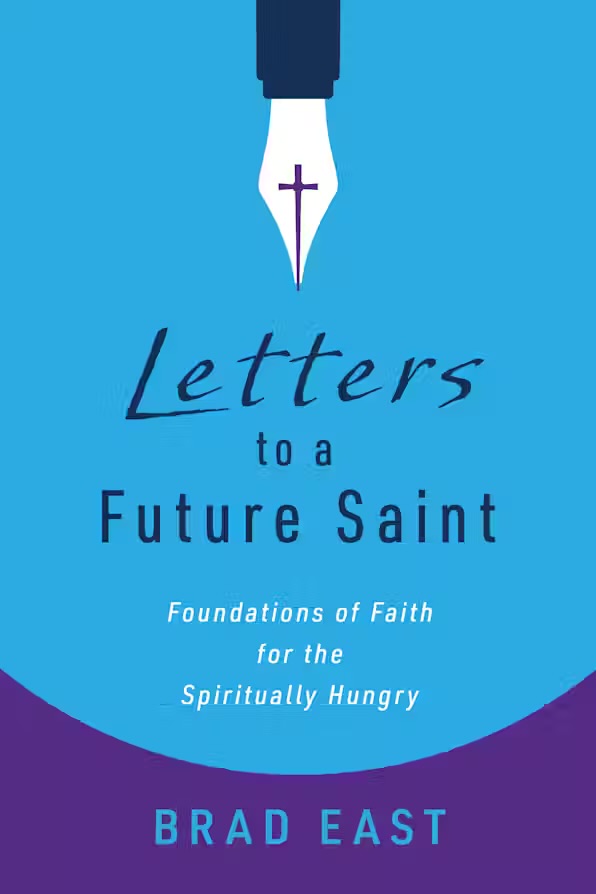
East earned the Award of Merit for his latest book, Letters to a Future Saint: Foundations of Faith for the Spiritually Hungry. Also cited were fellow ACU professors Dr. Mark Hamilton and Dr. Samjung Kang-Hamilton.
The Award of Merit is the runner-up for Book of the Year, according to a news release from Christianity Today. East’s intriguing title, “Letters to a Future Saint,” implies that it is geared toward younger folks. That is true, but it also is for older folks, too.
“I wrote it for my students and for other young people,” East said in a news release, “but I secretly wrote it for parents and pastors, too.”

BIO
Position: Associate professor of theology at Abilene Christian University
Education: PhD, Yale University (2017); MDiv, Emory University (2011); BA, Abilene Christian University (2007)
Previous books: The Church: A Guide to the People of God (Christian Essentials), 2024; The Church’s Book: Theology of Scripture in Ecclesial Context, 2022; The Doctrine of Scripture, 2021;
Q Your target audience is 18-to-25-year-olds and your own children. However, you said you secretly wrote it for parents and pastors, too. Why is that?
A First, because the primary teachers and “catechists” of children of all ages is their own parents, along with pastors, leaders, and volunteers at church. Second, because in my experience it’s not only Gen Alpha and Gen Z that need theological instruction and spiritual formation in the basics of the Christian faith; it’s their parents, too. Most Millennials I know feel unequipped to train their children in the beliefs and practices of the gospel. My hope is that those who read this book will feel more equipped as a result.
Q What are some of the topics covered in your letters?
A Just about everything you might imagine that is relevant to living and believing as a Christian. Major doctrines like salvation, incarnation, and the Trinity. Major scriptural themes like election, Israel, covenant, and gentiles. Moral questions like sex, money, and power. Liturgical topics like worship, prayer, and the sacraments. There’s a lot squeezed in there!
Q Why do you refer to your audience as “future saints”?
A It’s riffing on a couple quotes. One is from the French Catholic novelist Leon Bloy, who is supposed to have written: “The only real sadness, the only real failure, the only great tragedy in life, is not to become a saint.” The second is by another French Catholic novelist, François Mauriac: “It is never too late to become a saint.”
Sainthood means holiness, and all Christians are called to lives of holiness, a process that will not be completed in this life, and one that God alone can work in us. The theological term is “sanctification.” Every baptized believer both is a saint (made holy by faith, through baptism) and will become one (in the next life, when Christ completes the work he began in us). So I’m writing to younger pilgrims on the journey of faith who are bound for sainthood like every disciple of Jesus.
Q What led you to write this book? Observing your students and their interests? Your children? Something more personal?
A All of the above. I’ve long had the habit of writing short letters to my children, godchildren, and nephews, especially on the day of their baptism. Observing my students in the classroom led to the idea that perhaps they might benefit from similar letters, covering the whole gamut of the faith. This book is the result.
Q A news release describes your letters as “bite-sized.” Why did you choose that format?
A Simple: Young people aren’t readers, and long chapters are intimidating. I wanted to offer something that might entice them without scaring them.
Q A blurb on the publisher’s website says your book interweaves scripture, poetry, and theological writings to educate readers in the richness of the Christian tradition. Please give one example of this interweaving.
A Well, the interweaving is something that happens across the letters as a whole. One may quote a poem by Franz Wright or Luci Shaw; another might excerpt Saint Augustine or Julian of Norwich; and Scripture is present throughout. Part of my goal was not just literary, but historical: I wanted readers who lack any sense of Christianity’s two thousand year history to come to see, or feel, that history as “populated” rather than bare. Believers today with no sense of Christian tradition need to develop deep roots in the past to weather the storms of tomorrow.
Q What encouraging traits do you see in your students?
A They are energetic, earnest, open-minded, and eager to follow Christ.
Q What discouraging traits do you see in your students?
A By and large they are biblically illiterate and literally illiterate—that is, they aren’t well formed in the Scriptures and they don’t, for the most part, read books. New habits of literacy are difficult to begin forming in one’s twenties!
Q Do you wish you had had this book to read when you were 18-to-25 years old?
A Yes, although I’m fortunate to have had different books—far better books, but covering similar topics—placed in my hands as a teenager. Books by authors like C. S. Lewis, G. K. Chesterton, and Dietrich Bonhoeffer. I have my youth minister to thank for that. Then I was ready to read more theology once I came to college.
 Spirit Of Abilene